
Top
NPC Online Library
NPC Law Library
NPC Noise News
NPC Resources
NPC Home
Top
NPC Online Library
NPC Law Library
NPC Noise News
NPC Resources
NPC Home
Top
NPC Online Library
NPC Law Library
NPC NoiseNews
NPC Resources
NPC Home
| Page No. | ||
| Figure 1: | Reference Energy Mean Emission Levels | 22 |
| Figure 2: | Noise Barrier Examples | 32 |
| Figure 3: | Noise Barrier Shadow Zone | 33 |
| Figure 4: | Vegetation | 37 |
| Figure 5: | Buffer Zones | 38 |
Top
NPC Online Library
NPC Law Library
NPC NoiseNews
NPC Resources
NPC Home
Studies have shown that some of the most pervasive sources of noise in our environment today are those associated with transportation. Traffic noise tends to be a dominant noise source in our urban as well as rural environment. In response to the problems associated with traffic noise, the United States code of Federal Regulations Part 772 (23 CFR 772), "Procedures for Abatement of Highway Traffic Noise and Construction Noise," establishes standards for mitigating highway traffic noise.
The purpose of this document is to provide Federal Highway Administration (FHWA) policies and guidance for the analysis and abatement of highway traffic noise. A 3 1/2-day training course, sponsored by the National Highway Institute, is available for instructing FHWA field and State highway agency (SHA) staffs in the details of the policies and the technical procedures required for analyzing and abating traffic noise impacts.
Effective control of the undesirable effects of highway traffic noise requires that (1) land use near highways be controlled, (2) vehicles themselves be quieted, and (3) mitigation of noise be undertaken on individual highway projects.
The first component is traditionally an area of local responsibility. The other components are the joint responsibility of private industry and of Federal, State, and local governments.
A. Land Use Planning and Control
The Federal Government has essentially no authority to regulate land use planning or the land development process. The FHWA and other Federal agencies encourage State and local governments to practice land use planning and control in the vicinity of highways. The FHWA advocates that local governments use their power to regulate land development in such a way that noise-sensitive land uses are either prohibited from being located adjacent to a highway, or that the developments are planned, designed, and constructed in such a way that noise impacts are minimized.
Some State and local governments have enacted legislative statutes for land use planning and control. As an example, the State of California has legislation on highway noise and compatible land use development. This State legislation requires local governments to consider the adverse environmental effects of noise in their land development process. In addition, the law gives local governments broad powers to pass ordinances relating to the use of
-1-
Top
NPC Online Library
NPC Law Library
NPC NoiseNews
NPC Resources
NPC Home
land, including among other things, the location, size, and use of buildings and open space. Wisconsin has a State law which requires formal adoption of a local resolution supporting the construction of a proposed noise barrier and documenting the existence of local land use controls to prevent the future need for noise barriers adjacent to freeways and expressways.
Although some other states and local governments have similar laws, the entire issue of land use is extremely complicated with a vast array of competing considerations entering into any actual land use control decisions. For this reason, it is nearly impossible to measure the progress of using land use to control the effects of noise.
The Noise Control Act of 1972 gives the Federal Environmental Protection Agency (EPA) the authority to establish noise regulations to control major sources of noise, including transportation vehicles and construction equipment. In addition, this legislation requires EPA to issue noise emission standards for motor vehicles used in Interstate commerce (vehicles used to transport commodities across State boundaries) and requires the FHWA office of Motor Carrier Safety (OMCS) to enforce these noise emission standards. The EPA has established regulations which set emission level standards for newly manufactured medium and heavy trucks that have a gross vehicle weight rating (GVWR) of more than 4,525 kilograms and are capable of operating on a highway or street. Table 1 shows the maximum noise emission levels allowed by the EPA noise regulations for these vehicles.
Table 1: Maximum Noise Emission Levels as Required by EPA for Newly Manufactured Trucks with GVWR Over 4,525 Kilograms
| Effective Date | Maximum Noise Level 15 Meters from Centerline of Travel* |
| January 1, 1988 | 80 dBA |
* Using the Society of Automotive Engineers, Inc. (SAE), test procedure for acceleration under 56 kph
For existing (in-use) medium and heavy trucks with a GVWR of more than 4,525 kilograms, the Federal government has authority to regulate the noise emission levels only for those that are engaged in interstate commerce. Regulation of all other in-use vehicles must be done by State or local governments. The EPA emission level standards for in-use medium and heavy trucks engaged in interstate commerce are shown in Table 2 and are enforced b the FHWA OMCS.
-2-
Top
NPC Online Library
NPC Law Library
NPC NoiseNews
NPC Resources
NPC Home
Table 2: Maximum Noise Emission Levels as Required by EPA for In-Use Medium and Heavy Trucks with GVWR Over 4,525 Kilograms Engaged in Interstate Commerce
| Effective Date | Speed | Maximum Noise Level 15 Meters from Centerline of Travel |
| January 8, 1986 | < 56 kph | 83 dBA |
| January 8, 1986 | > 56 kph | 87 dBA |
| January 8, 1986 | Stationary | 85 dBA |
C. Highway Project Noise Mitigation
The National Environmental Policy Act (NEPA) of 1969 provides broad authority and responsibility for evaluating and mitigating adverse environmental effects including highway traffic noise. The NEPA directs the Federal government to use all practical means and measures to promote the general welfare and foster a healthy environment.
A more important Federal legislation which specifically involves abatement of highway traffic noise is the Federal-Aid Highway Act of 1970. This law mandates FHWA to develop noise standards for mitigating highway traffic noise.
The law requires promulgation of traffic noise-level criteria for various land use activities. The law further provides that FHWA not approve the plans and specifications for a federally aided highway project unless the project includes adequate noise abatement measures to comply with the standards. The FHWA has developed and implemented regulations for the mitigation of highway traffic noise in federally aided highway projects.
The FHWA regulations for mitigation of highway traffic noise in the planning and design of federally aided highways are contained in 23 CFR 772. The regulations require the following during the planning and design of a highway project: (1) identification of traffic noise impacts; (2) examination of potential mitigation measures; (3) the incorporation of reasonable and feasible noise mitigation measures into the highway project; and (4) coordination with local officials to provide helpful information on compatible land use planning and control. The regulations contain noise abatement criteria which represent the upper limit of acceptable highway traffic noise for different types of land uses and human activities. The regulations do not
-3-
Top
NPC Online Library
NPC Law Library
NPC NoiseNews
NPC Resources
NPC Home
require that the abatement criteria be met in every instance. Rather, they require that every reasonable and feasible effort be made to provide noise mitigation when the criteria are approached or exceeded, compliance with the noise regulations is a prerequisite for the granting of Federal-aid highway funds for construction or reconstruction of a highway.
As we all know, sound is created when an object moves; the rustling of leaves as the wind blows, the air passing through our vocal chords, the almost invisible movement of the speakers on a stereo. The movements cause vibrations of the molecules in air to move in waves like ripples on water when the vibrations reach our ears, we hear what we call sound.
Noise is defined as unwanted sound. Sound is produced by the vibration of sound pressure waves in the air. Sound pressure levels are used to measure the intensity of sound and are described in terms of decibels. The decibel (dB) is a logarithmic unit which expresses the ratio of the sound pressure level being measured to a standard reference level. Sound is composed of various frequencies, but the human ear does not respond to all frequencies. Frequencies to which the human ear does not respond must be filtered out when measuring highway noise levels. Sound-level meters are usually equipped with weighting circuits which filter out selected frequencies. It has been found that the A-scale on a sound-level meter best approximates the frequency response of the human ear. Sound pressure levels measured on the A-scale of a sound meter are abbreviated dBA.
In addition to noise varying in frequency, noise intensity fluctuates with time. In the past few years, there has been a definite trend toward the use of the equivalent (energy-average) sound level as the descriptor of environmental noise in the U.S. The equivalent sound level is the steady- state, A-weighted sound level which contains the same amount of acoustic energy as the actual time-varying, A-weighted sound level over a specified period of time. If the time period is 1 hour, the descriptor is the hourly equivalent sound level, Leq(h), which is widely used by SHAs as a descriptor of traffic noise. An additional descriptor, which is sometimes used, is the L10. This is simply the A-weighted sound level that is exceeded 10 percent of the time.
A few general relationships may be helpful at this time in understanding sound generation and propagation. First, as already mentioned above, decibels are logarithmic units. Consequently, sound levels cannot be added by ordinary arithmetic means. A chart for decibel addition is shown in Table 1. From this table it can be seen that the sound pressure level from two equal sources is 3 dB greater than the sound pressure level of just one source. Therefore, two trucks producing 90 dB each will combine to produce 93 dB, not 180 dB. In other words, a doubling of the noise source produces only a 3 dB increase in the sound pressure level. Studies have shown that this increase is barely detectable by the human ear.
-4-
Top
NPC Online Library
NPC Law Library
NPC NoiseNews
NPC Resources
NPC Home
Table 3: Decibel Changes, Loudness, and Energy Loss
| Sound Level Change | Relative Loudness | Acoustic Energy Loss |
| 0 dBA | Reference | 0 |
| -3 dBA | Barely Perceptible Change | 50% |
| -5 dBA | Readily Perceptible Change | 67% |
| -10 dBA | Half as Loud | 90% |
| -20 dBA | 1/4 as Loud | 99% |
| -30 dBA | 1/8 as Loud | 99.9% |
Table 4: Rules for Combining Sound Levels by "Decibel Addition"
For noise levels known or desired to an accuracy of +/- 1 decibel (acceptable for traffic noise analyses:
| When two decibel values differ by | Add the following amount to the higher value |
| 0 or 1 dB | 3 dB |
| 2 or 3 dB | 2 dB |
| 4 or 9 dB | 1 dB |
| 10 dB or more | 0 dB |
Secondly, an increase or decrease of 10 dB in the sound pressure level will be perceived by an observer to be a doubling or halving of the sound. For example, a sound at 70 dB will sound twice as loud as a sound at 60 dB.
Finally, sound intensity decreases in proportion with the square of the distance from the source. Generally, sound levels for a point source will decrease by 6 dBA for each doubling of distance. Sound levels for a highway line source vary differently with distance, because sound pressure waves are propagated all along the line and overlap at the point of measurement. A long, closely spaced continuous line of vehicles along a roadway becomes a line source and produces a 3 dBA decrease in sound level for each doubling of distance. However, experimental evidence has shown that where sound from a highway propagates close to "soft" ground (e.g., plowed farmland, grass, crops, etc.), the most suitable dropoff rate to use is not 3 dBA but rather 4.5 dBA per distance doubling. This 4.5 dBA dropoff rate is usually used in traffic noise analyses.
For the purpose of highway traffic noise analyses, motor vehicles fall into one of three categories: (1) automobiles - vehicles with two axles and four wheels, (2) medium trucks - vehicles with two axles and six wheels, and (3) heavy trucks - vehicles with three or more axles. The emission levels of all three vehicle types increase as a function of the logarithm of their speed.
-5-
Top
NPC Online Library
NPC Law Library
NPC NoiseNews
NPC Resources
NPC Home
The level of highway traffic noise depends on three things: (1) the volume of. the traffic, (2) the speed of the traffic, and (3) the number of trucks in the flow of the traffic. Generally, the loudness of traffic noise is increased by heavier traffic volumes, higher speeds, and greater numbers of trucks. Vehicle noise is a combination of the noises produced by the engine, exhaust, and tires. The loudness of traffic noise can also be increased by defective mufflers or other faulty equipment on vehicles. Any condition (such as a steep incline) that causes heavy laboring of motor vehicle engines will also increase traffic noise levels. In addition, there are other, more complicated factors that affect the loudness of traffic noise. For example, as a person moves away from a highway, traffic noise levels are reduced by distance, terrain, vegetation, and natural and manmade obstacles. Traffic noise is not usually a serious problem for people who live more than 150 meters from heavily traveled freeways or more than 30 to 60 meters from lightly traveled roads.
The current FHWA procedures for highway traffic noise analysis and abatement are contained in 23 CFR 772, "Procedures for Abatement of Highway Traffic Noise and Construction Noise." These procedures specify the requirements that SHAs must meet when using Federal-aid funds for highway projects.
This discussion will address those requirements and point out the most important issues related to the requirements. Each paragraph of 23 CFR 772 will be presented in boldface type and followed by a discussion of that paragraph. Some parts are self-explanatory and need only a sentence or two of discussion. Other, more complicated paragraphs will have greater discussion.
772.1: PURPOSE. To provide procedures for noise studies and noise abatement measures to help protect the public health and welfare, to supply noise abatement criteria, and to establish requirements for information to be given to local officials for use in the planning and design of highways approved pursuant to Title 23, United States Code (U.S.C.).
The protection of the public's health and welfare is an important responsibility that FHWA helps to accomplish during the planning and design of a highway project. The U.S. Congress has directed that this be done when the 1970 Federal-Aid Highway Act was passed. Concerned citizens and States encouraged Congress to provide this protection.
772.3: NOISE STANDARDS. The highway traffic noise prediction requirements, noise analyses, noise abatement criteria, and requirements for informing local officials in this directive constitute the noise standards mandated by 23 U.S.C. 109(i). All highway projects which are developed in conformance with this directive shall be deemed to be in conformance with the Federal Highway Administration (FHWA) noise standards.
-6-
Top
NPC Online Library
NPC Law Library
NPC NoiseNews
NPC Resources
NPC Home
This paragraph makes the whole 23 CFR 772 the FHWA noise standard. The standard is required by 23 U.S.C. 109 (i). Some people mistake the noise abatement criteria for the FHWA standard. Early on, FHWA did not want to be restricted to specific noise levels that may not be achieved in most highway projects. So, a standard was developed that would best serve the public in terms of protection and reasonable cost.
a. Design Year - the future year used to estimate the probable traffic volume for which a highway is designed. A time, 10 to 20 years, from the start of construction is usually used.
b. Existing Noise Levels - the noise, resulting from the natural and mechanical sources and human activity, considered to be usually present in a particular area.
c. L10 - the sound level that is exceeded 10 percent of the time (the 90th percentile) for the period under consideration.
d. L10(h) - the hourly value of L10.
e. Leq - the equivalent steady-state sound level which in a stated period of time contains the same acoustic energy as a time-varying sound level during the same period.
f. Leq(h) - the hourly value of Leq.
g. Traffic Noise Impacts - impacts which occur when the predicted traffic noise levels approach or exceed the noise abatement criteria (Table 5), or when the predicted traffic noise levels substantially exceed the existing noise levels.
h. Type I Projects - a proposed Federal or Federal-aid highway project for the construction of a highway on new location or the physical alteration of an existing highway which significantly changes either the horizontal or vertical alignment or increases the number of through-traffic lanes.
i. Type II Projects - a proposed Federal or Federal-aid highway for noise abatement on an existing highway.
Most of these definitions are self-explanatory. However, the definition for "Traffic Noise Impacts" warrants further attention. A traffic noise impact occurs when the predicted levels approach or exceed the noise abatement criteria (NAC) or when predicted traffic noise levels substantially exceed the existing noise level, even though the predicted levels may not exceed the NAC. This definition reflects the FHWA position that traffic noise impacts can occur under either of two separate conditions: (1) when noise levels are
-7-
Top
NPC Online Library
NPC Law Library
NPC NoiseNews
NPC Resources
NPC Home
unacceptably high (absolute level); or (2) when a proposed highway project will substantially increase the existing noise environment (substantial increase). In order to adequately assess the noise impact of a proposed project, both criteria must be analyzed. While the FHWA noise regulations do not define "approach or exceed, all SHAs must establish a definition of "approach" that is at least 1 dBA less than the NAC for use in identifying traffic noise impacts in traffic noise analyses.
Table 5: Noise Abatement Criteria (NAC) Hourly A-Weighted Sound Level in Decibels (dBA)*
| Activity Category | Leq(h) | L10(h) | Description of Activity Category |
| A | 57
(Exterior) |
60
(Exterior) |
Lands on which serenity and quiet are of extraordinary
significance and serve an important public need and where the
preservation of those qualities is essential if the area is to continue
to serve its intended purpose.
|
| B | 67
(Exterior) |
70
(Exterior) |
Picnic areas, recreation areas, playgrounds, active
sports areas, parks, residences, motels, hotels, schools, churches,
libraries, and hospitals.
|
| C | 72
(Exterior) |
75
(Exterior) |
Developed lands, properties, or activities not included
in Categories A or B above.
|
| D | -- | -- | Undeveloped lands.
|
| E | 52
(Interior) |
55
(Interior) |
Residences, motels, hotels, public meeting rooms, schools, churches, libraries, hospitals, and auditoriums. |
* Either Leq(h) or L10(h) (but not both) may be used on a project.
NOTE: These sound levels are only to be used to determine impact. These are the absolute levels where abatement must be considered. Noise abatement should be designed to achieve a substantial noise reduction - not the noise abatement criteria.
-8-
Top
NPC Online Library
NPC Law Library
NPC NoiseNews
NPC Resources
NPC Home
In developing the NAC contained in the noise regulations the FHWA attempted to strike a balance between that which is most desirable and that which is feasible. Factors such as technical feasibility, the unique characteristics of highway-generated noise, cost, overall public interest, and other agency objectives were important elements in the process of setting a standard. Establishing values for the NAC was approached by attempting to balance the control of future increases in highway noise levels and the economic, physical, and aesthetic considerations related to noise abatement measures. Numerous approaches were considered in establishing the criteria, including (1) hearing impairment, (2) annoyance, sleep, and task interference or disturbance, and (3) interference with speech communication. The first deals in terms of very loud noises seldom encountered for a highway project beyond the roadway proper. The second approach was desirable in principle but was insufficiently researched to be useful in practice. However, the third approach - speech interference - was usefully applied to the problem of highway traffic noise. Thus, it should be remembered that the NAC are based upon noise levels associated with interference of speech communication and that the NAC are a compromise between noise levels that are desirable and those that are achievable. FHWA believes that our regulations provide a well-balanced approach to the problem of highway-traffic-generated noise.
The NAC are not magical numbers. Traffic noise impacts can occur below the NAC. The NAC should not be viewed as Federal standards or desirable noise levels; they should not be used as design goals for noise barrier construction. All of the regulations contained in 23 CFR 772 constitute the standards mandated by the Federal-Aid Highway Act of 1970. Noise abatement should be designed to achieve a substantial noise reduction, which SHAs have defined in practice to be in the range of 5-10 dBA. The NAC should only be used as absolute values which, when approached or exceeded, require the consideration of traffic noise abatement measures.
The 23 CFR 772 purposefully provides the SHAs with flexibility to establish their own definition of "substantial increase." A 10 dBA increase in noise levels is a doubling of the perceived loudness. A 15 dBA increase in noise levels represents more than a doubling of the loudness. Factors such as available resources, the public's attitudes toward highway traffic noise, and the absolute noise levels may influence a state's definition. The FHWA will accept a well-reasoned definition that is uniformly and consistently applied. Several SHA definitions have evolved and are shown in Table 6.
-9-
Top
NPC Online Library
NPC Law Library
NPC NoiseNews
NPC Resources
NPC Home
Table 6: Criteria Used by States to Define "Substantial"
| Increase (dB) | Subjective Descriptor | |
| Criteria 1 | 0 - 5 | Little increase |
| 5 - 15 | Some increase | |
| > 15 | Substantial increase | |
| Criteria 2 | < 10 | Little increase |
| > 10 | Substantial increase | |
| Criteria 3 | 0 - 5 | No increase |
| 5 - 10 | Minor increase | |
| 10 - 15 | Moderate increase | |
| > 15 | Substantial increase |
The use of subjective descriptors to describe traffic noise impacts is not required. Traffic noise impacts "occur based upon the definition contained in 23 CFR 772. This definition does not contain subjective descriptors. If impacts are identified, noise abatement measures must be considered and implemented if found to be reasonable and feasible. When analyzing the reasonableness of abatement, SHAs should consider the relationship between the absolute noise levels and the extent of the increase over existing noise levels for a given situation. A small increase at a higher absolute level (e.g., 70 dBA to 75 dBA) can be more important and justify greater consideration than a similar increase at a lower absolute level (e.g, 50 dBA to 55 dBA). Likewise, a large increase at a lower absolute level (e.g., 40 dBA to 55 dBA) can be less important and justify less consideration than a similar increase at a higher absolute level (e.g., 55 dBA to 70 dBA).
a. Type I Projects. This directive applies to all Type I projects unless it is specifically indicated that a section applies only to Type II projects.
b. Type II Projects. The development and implementation of Type II projects are not mandatory requirements of 23 U.S.C. 109(i) and are, therefore, not required by this directive. When Type II projects are proposed for Federal-aid highway participation at the option of the highway agency, the provisions of paragraphs 6, 8, and 11 of this directive shall apply.
The regulation applies to all Type I and Type II projects. The implementation of a Type II program is optional and not mandatory.
-10-
Top
NPC Online Library
NPC Law Library
NPC NoiseNews
NPC Resources
NPC Home
772.9: ANALYSIS OF TRAFFIC NOISE IMPACTS AND ABATEMENT MEASURES
a. The highway agency shall determine and analyze expected traffic noise impacts and alternative noise abatement measures to mitigate there impacts, giving weight to the benefits and cost of abatement, and to the overall social, economic and environmental effects. (1)
b. The traffic noise analysis shall include the following for each alternative under detailed study:
(1) identification of existing activities, developed lands, and undeveloped lands for which development is planned, designed and programmed, which may be affected by noise from the highway;
(2) prediction of traffic noise levels;
(3) determination of existing noise levels;
(4) determination of traffic noise impacts; and
(5) examination and evaluation of alternative noise abatement measures for reducing or eliminating the noise impacts.
c. Highway agencies proposing to use Federal-aid highway funds for Type II projects shall perform a noise analysis of sufficient scope to provide information needed to make the determination required by paragraph 772.13a of this directive.
Paragraph 772.9a is the major requirement for doing noise analyses on all Type I projects. However, this requirement includes the evaluation of noise reduction benefits, abatement cost, and social, economic, and environmental (SEE) effects. This evaluation requires a balancing by the SHA of benefits versus disbenefits. This can be a difficult task because very little guidance exists on this topic. Noise reduction benefits and abatement cost will be discussed in detail in paragraph 772.ll. The process of balancing noise abatement and the SEE effects of the mitigation is strongly influenced by the public involvement process. The people who live next to the highway project can best evaluate if the abatement benefits will outweigh the SEE effects. The SHAs should not do this evaluation without public involvement. It is also important to remember that noise abatement consideration should be an inherent project consideration that is not handled separately but is incorporated and considered in the total project development decision.
Paragraph 772.9b lists the minimum requirements needed to adequately evaluate the impacts and abatement for each alternative under detailed study for the proposed highway project. The analysis should present the noise impacts and evaluation of alternative abatement measures in a comparative format. In this way, the potential noise impacts and likely abatement measures associated with
-11-
Top
NPC Online Library
NPC Law Library
NPC NoiseNews
NPC Resources
NPC Home
the various alternatives, including the "no-build" alternative, are clearly defined. Detailed procedures on how to do the analysis exists in the text of the National Highway Institute noise training course, "Fundamentals and Abatement of Highway Traffic Noise."
Paragraph 772.9b(1) requires the identification of existing activities and developed lands. This identification includes not only the type (e.g., residential, commercial), but the number or extent of activities. This quantification is often overlooked in the analysis. The extent of the noise impact on the people living near the highway project cannot be evaluated correctly without the quantification of the existing activities.
Paragraph 772.9b(1) also requires noise analysis for undeveloped lands for which development is "planned, designed, and programmed." The terms "... planned, designed, and programmed ..." mean that: 1) a definite commitment has been made to develop the property in question, and 2) there is also official knowledge (such as through a public agency) that such development has been "planned, designed, and programmed." A definite commitment means that a developer has shown a definite interest to develop the land within a reasonable period of time and has reached a point where he can no longer practically change his plans.
The exact date for determining when undeveloped land is "... planned, designed, and programmed ..." for development is not specified in 23 CFR 772. Each SHA and accompanying FHWA Division office should establish a mutually acceptable specific date that is appropriate for the development process in their respective State. One specific date that has evolved is the date of issuance of a building permit, other dates used by States include the date of final approval of the development plan and the date of recording of the plat plan. . Any of these dates are in conformance with FHWA policy.
772.ll: NOISE ABATEMENT
a. In determining and abating traffic noise impacts, primary consideration is to be given to exterior areas. Abatement will usually be necessary only where frequent human use occurs and a lowered noise level would be of benefit.
b. In those situations where there are no exterior activities to be affected by the traffic noise, or where the exterior activities are far from or physically shielded from the roadway in a manner that prevents an impact on exterior activities, the interior criterion shall be used as the basis of determining noise impacts.
In most situations, if the exterior area can be protected, the interior will also be protected. The selection of the exterior area where "frequent human use occurs" is very important. This requires a site visit to determine whether people are using the entire exterior area or only a small portion, like a patio or porch. Some States choose the right-of-way line (a point farthest away from a house) to be on the conservative side when doing the noise impact analysis. Interior use applies mostly to hospitals and schools.
-12-
Top
NPC Online Library
NPC Law Library
NPC NoiseNews
NPC Resources
NPC Home
Interior noise level predictions may be computed by subtracting from the predicted exterior levels the noise reduction factors for the building in question. If field measurements of these noise reduction factors are obtained or the factors are calculated from detailed acoustical analyses, the measured or calculated reduction factors should be used. In the absence of such calculations or field measurements, the noise reduction factors may be obtained from the following table:
Table 7: Building Noise Reduction Factors
| Building Type | Window Condition | Noise Reduction Due to Exterior of the Structure |
| All | Open | 10 dB |
| Light Frame | Ordinary Sash (closed) | 20 dB |
| Storm Windows | 25 dB | |
| Masonry | Single Glazed | 25 dB |
| Masonry | Double Glazed | 35 dB |
NOTE: The windows shall be considered open unless there is firm knowledge that the windows are in fact kept closed almost every day of the year.
c. If a noise impact is identified, the abatement measures listed in paragraph 772.13c of this directive must be considered.
This self-explanatory paragraph requires consideration of noise abatement when noise impacts occur. As noted in paragraph 772.5g, noise impacts occur when noise levels approach or exceed the noise abatement criteria or when predicted levels substantially exceed existing levels. Consequently, this paragraph requires consideration of noise abatement for both of these types of noise impacts.
d. When noise abatement measures are being considered, every reasonable effort shall be made to obtain substantial noise reductions.
Abatement must provide at least a 5 dBA reduction in highway traffic noise levels in order to provide noticeable and effective attenuation. When noise abatement is proposed, it is recommended that an attempt be made to achieve the greatest reduction possible. SHAs have generally defined substantial reduction to be in the range of 5-10 dBA.
-13-
Top
NPC Online Library
NPC Law Library
NPC NoiseNews
NPC Resources
NPC Home
This paragraph does not say to reduce the noise abatement criteria; it says "substantial noise reductions." Consequently, a projected noise level of Leq 69 for a Category B activity (see Table 5) should not be abated merely to the noise abatement criterion of Leq 67, but rather a substantial reduction should be obtained (at least 5 dBA). The choice of what minimum reduction to strive for is certainly a subjective one and is probably related to data found in technical literature, such as the following table.
Table 8: Relationship Between Decibel, Energy, and Loudness
| A- Level Down | Remove____% of Energy | Divide Loudness by |
| 3 dBA | 50 | 1.2 |
| 6 dBA | 75 | 1.5 |
| 10 dBA | 90 | 2 |
| 20 dBA | 99 | 4 |
A reduction of 10 dBA (say 75 dBA to 65 dBA) will be perceived by the public as a halving of the loudness. This is an easily recognizable change. 5 dBA and 7 dBA changes can also be recognized, but to a lesser degree. Two points should be kept in mind: (1) any reduction will improve the noise environment in such areas as annoyance, speech interference, task interference, etc., and (2) no matter what the reduction, until the level reaches a very low level (about Leq = 55 dBA), the noise environment will continue to be dominated by traffic noise that is clearly audible.
e. Before adoption of a final environmental impact statement or finding of no significant impact, the highway agency shall identify:
(1) noise abatement measures which are reasonable and feasible and which are likely to be incorporated in the project, and
(2) noise impacts for which no apparent solution is available.
This paragraph ties the noise regulation to the NEPA requirements. An important point is that the requirements for the draft environmental impact statement (EIS) are the same as the final. Therefore, the information for both 772.lle(1) and 772.lle(2) are needed in the draft EIS and the final EIS. The choice of the word "likely" was deliberate. If a decision maker is to make an informed decision and if the public is to be made aware of the impacts, the State must make its intentions known. If the State later decides that mitigation is not warranted, the decision should have strong support. If the
-14-
Top
NPC Online Library
NPC Law Library
NPC NoiseNews
NPC Resources
NPC Home
State would like to qualify the word "likely," this is acceptable. When a project involves consideration of more than one barrier, a statement of “likelihood” for each barrier should be included in the environmental document. The following is an illustration of some appropriate words.
Based on the studies so far accomplished, the State intends to install noise abatement measures in the form of a barrier at______________________________. These preliminary indications of likely abatement measures are based upon preliminary design for a barrier cost of $____________ that will reduce the noise level by ________ dBA for ___________ residents. If it subsequently develops during final design that these conditions have substantially changed, the abatement measures might not be provided. A final decision of the installation of the abatement measure(s) will be made upon completion of the project design and the public involvement processes.
f. The views of the impacted residents will be a major consideration in reaching a decision on the reasonableness of abatement measures to be provided.
The views of the impacted residents should be a major consideration if determining the reasonableness of traffic noise abatement measures for proposed highway construction projects. The views should be determined and addressed during the environmental phase of project development. The will and desires of the general public should be an important factor in dealing with the overall problems of highway traffic noise. SHAs should incorporate traffic noise consideration in their on-going activities for public involvement in the highway program, i.e., the residents' views on the desirability and acceptability of abatement need to be reexamined periodically during project development.
g. The plans and specifications will not be approved by FHWA unless those noise abatement measures which are reasonable and feasible are incorporated into the plans and specifications to reduce or eliminate the noise impact on existing activities, developed lands, or undeveloped lands for which development is planned, designed, and programmed.
This is a summary statement of the requirements in the 1970 Federal-Aid Highway Act [23 U.S.C. 109(i)].
The key words in this paragraph are "reasonable" and "feasible." For a thorough explanation of reasonableness and feasibility of abatement, see the discussion on pp. 50-56.
a. Federal funds may be used for noise abatement measures where:
(1) a traffic noise impact has been identified,
-15-
Top
NPC Online Library
NPC Law Library
NPC NoiseNews
NPC Resources
NPC Home
(2) the noise abatement measures will reduce the traffic noise impact, and
(3) the overall noise abatement benefits are determined to outweigh the overall adverse social, economic, and environmental effects and the costs of the noise abatement measures.
Paragraph 772.13a identifies the simple rules that guide the funding of noise abatement on highway projects. These rules apply to both Type I and Type II projects.
Federal-aid highway funds may not be used as payment or compensation for a traffic noise impact through the purchase of a noise easement from a property owner. The FHWA noise regulations clearly indicate that Federal funds may only be used to reduce traffic noise impacts and provide noise abatement benefits. Monetary compensation accomplishes neither of these requirements.
Federal-aid funds may be used in compensation paid during right-of-way negotiations for a partial taking of property. Noise, air quality, access, visual quality, etc. are frequently considered jointly in determining this compensation, which is regarded as part of right-of-way acquisition, not environmental mitigation.
b. For Type II projects, noise abatement measures will not normally be approved for chose activities and land uses which come into existence after May 14, 1976. However, noise abatement measures may be approved for activities and land uses which come into existence after May l4, 1976, provided local authorities have taken measures to exercise land use control over the remaining undeveloped lands adjacent to highways in the local jurisdiction to prevent further development of incompatible activities.
Paragraph 772.13b limits funding participation for retrofit barriers on existing highways because in 1976 FHWA publicly stated that local governments must help control noise impacts through noise-compatible land-use planning and zoning. However, it is important to remember that this paragraph does not prohibit the approval of Type II barriers after 1976. It says that the land use activity (housing development) built near a highway after 1976 usually cannot get a Type II barrier unless the local government has an active land use control program to prevent future incompatible activities (e.g., zoning requirements, noise-sensitive growth and development procedures, local ordinances). The FHWA has not rigidly applied this requirement in the past. However, after the date of issuance of this guidance Type II abatement projects for new activities and land uses which come into existence may only be approved if an active local land use control program was adopted prior to existence of the new activities and land uses. EXAMPLE: A Type II noise barrier is requested for homes that were constructed prior to a local community's adoption of an active noise-compatible land use control program. Type II abatement may not be approved for this location. SHAs should be certain to make local officials aware of this requirement (see paragraph 772.15 on page 18).(2)
-16-
Top
NPC Online Library
NPC Law Library
NPC NoiseNews
NPC Resources
NPC Home
c. The noise abatement measures listed below may be incorporated in Type I and Type II projects to reduce traffic noise impacts. The costs of such measures may be included in Federal-aid participating project costs with the Federal share being the same as that for the system on which the project is located, except that Interstate construction funds may only participate in Type I projects.
(1) traffic management measures (e.g., traffic control devices and signing for prohibition of certain vehicle types, time-use restrictions for certain vehicle types, modified speed limits, and exclusive land designations),
(2) alteration of horizontal and vertical alignments,
(3) acquisition of property rights (either in fee or lesser interest) for construction of noise barriers,
(4) construction of noise barriers (including landscaping for aesthetic purposes) whether within or outside the highway right-of-way. Interstate construction funds may not participate in landscaping,
(5) acquisition of real property or interests therein (predominately unimproved property) to serve as a buffer zone to preempt development which would be adversely impacted by traffic noise. This measure may be included in Type I projects only, and
(6) noise insulation of public use or nonprofit institutional structures.
Two important points about this paragraph are: (1) the participating share is the same as that for the system on which the project is located; (2) buffer zones can only be used in Type I projects. The potential use of buffer zones applies to predominantly unimproved property. This authority is not used to purchase homes or developed property to create a noise buffer zone. It is used to purchase unimproved property to preclude future noise impacts where development has not yet occurred.
Although most noise mitigation has been implemented along Interstate highways, Federal funds may be used for mitigation measures along other types of highways if the noise impacts exist and the criteria in 772.13a are met.
The most-used abatement measure is the noise barrier; however, paragraph 772.llc requires consideration of all the abatement measures listed in paragraph 772.13c. Noise insulation may only routinely be considered for public use or nonprofit institutional structures, e.g., churches, schools, hospitals, libraries, etc. Private dwellings may only be noise-insulated under the provisions of section 772.13d.
-17-
Top
NPC Online Library
NPC Law Library
NPC NoiseNews
NPC Resources
NPC Home
The purchase of a noise easement, in locations where traffic noise impacts are expected to occur or already exist, should not be considered as a noise abatement measure. It does not reduce noise levels or abate the impacts. It only provides monetary compensation and is, thus, not eligible for Federal-aid participation.
d. There may be situations where (1) severe traffic noise impacts exist or are expected., and (2) the abatement measures listed above are physically infeasible or economically unreasonable. In these instances, noise abatement measures other than those listed in paragraph 771.13c of this directive may be proposed for Type I and II projects by the highway agency and approved by the Regional Federal Highway Administrator on a case-by-case basis when the conditions of paragraph 772.13a of this directive have been met.
This paragraph allows the States the flexibility to propose innovative noise abatement measures when severe traffic noise impacts are anticipated and normal abatement measures are physically infeasible or economically unreasonable. In these instances, the Regional Federal Highway Administrator may approve a state's request for unusual or extraordinary abatement measures on a case-by-case basis. When considering extraordinary abatement measures, the state must demonstrate that the affected activities experience traffic noise impacts to a far greater degree than other similar activities adjacent to highway facilities, e.g., residential areas with absolute noise levels of 75 dBA Leq(h) or more, residential areas with noise level increases of 30 dBA or more over existing noise levels. Examples of extraordinary abatement measures would be the noise insulation of private residences or the purchase of private dwellings from willing sellers.
772.15: INFORMATION FOR LOCAL OFFICIALS In an effort to prevent future traffic noise impacts on currently undeveloped lands, highway agencies shall inform local officials within whose jurisdiction the highway project is located of the following:
a. The best estimation of future noise levels (for various distances from the highway improvement) for both developed and undeveloped lands or properties in the immediate vicinity of the project,
b. Information that may be useful to local communities to protect future land development from becoming incompatible with anticipated highway noise levels, and
c. eligibility for Federal-aid participation for Type II projects as described in paragraph 772.13b of this directive.
The prevention of future impacts is one of the most important parts of noise control. The compatibility of the highway and its neighbors is essential for the continuing growth of local areas. Both development and highways can be compatible. But, local government officials need to know what noise levels to expect from a highway and what techniques they can use to prevent future impacts, states can help by providing this information to local governments; such information should be made available for disclosure in real estate transactions.(3)
-18-
Top
NPC Online Library
NPC Law Library
NPC NoiseNews
NPC Resources
NPC Home
Highway traffic noise should be reduced through a program of shared responsibility. Thus, the FHWA encourages state and local governments to practice compatible land use planning and control in the vicinity of highways. Local governments should use their power to regulate land development in such a way that noise-sensitive land uses are either prohibited from being located adjacent to a highway, or that the developments are planned, designed, and constructed in such a way that noise impacts are minimized. Local officials should be made aware of the requirement for the adoption of an active noise- compatible land use control program for approval of Type II abatement (see paragraph 772.13b on page 16).
772.17: TRAFFIC NOISE PREDICTION
a. Any traffic noise prediction method is approved for use in any noise analysis required by this directive if it generally meets the following two conditions:
(1) The methodology is consistent with the methodology in the FHWA Highway Traffic Noise Prediction Model (Report No. FHWA-RD-77-108).
(2) The prediction method uses noise emission levels obtained from one of the following:
(a) National Reference Energy Mean Emission Levels as a Function of Speed (Figure 1).
(b) Determination of reference energy mean emission levels in "Sound Procedures for Measuring Highway Noise: Final Report," Report No. DP-45-lR.
b. In predicting noise levels and assessing noise impacts, traffic characteristics which will yield the worst hourly traffic noise impact on a regular basis for the design year shall be used.
Most states use the FHWA highway traffic noise prediction model (FHWA model) with its national emission levels. If a state uses different emission levels, documentation must be provided to the FHWA Division Office to justify its use. Paragraph 772.17a(2)(b) specifies that the method in Report No. DP-45-lR be used to obtain these emission levels. The FHWA Division Office should forward the proposed emission levels to FHWA Headquarters for review and comment. Some states have modified computer versions of the FHWA model to change input/output characteristics to suit the state's design process.
Traffic characteristics used in predicting future noise levels could make a substantial difference in the results. "Worst hourly traffic noise impact" occurs at a time when truck volumes and vehicle speeds are the greatest, typically when traffic is free-flowing and at or near level of service C conditions. The numbers of medium and heavy trucks are very important.
-19-
Top
NPC Online Library
NPC Law Library
NPC NoiseNews
NPC Resources
NPC Home
SHAs should use either the posted speed limit or the operating speed (highest overall speed at which a driver can travel on a given highway under favorable weather conditions and under prevailing traffic conditions, without at any time exceeding the safe speed as determined by the design speed on a section-by-section basis) to predict traffic noise levels. SHAs are required to use the operating speed if it is determined to be consistently higher than the posted speed limit. In determining the operating speed along an existing highway, the first step is to identify the time period during which the worst traffic noise impacts are expected to occur. Then, the speed may be determined by actually driving a vehicle in the traffic stream and recording the average speed. It may also be determined by using radar meters or other devices to measure speeds at a point along the highway (making no adjustments to the actual instrument measurements). Such measured speeds are then arithmetically averaged to calculate a time mean speed (as defined in Highway Capacity Manual: Special Report 209). Either the "traffic stream" speed or the time mean speed can be used to represent the operating speed.
The following general steps are to be performed for all Types I and II projects:
a. Identify land uses or activities which may be affected by noise from construction of the project. The identification is to be performed during the project development studies.
b. Determine the measures which are needed in the plans and specifications to minimize or eliminate adverse construction noise impacts to the community. This determination shall include a weighing of the benefits achieved and the overall adverse social, economic, and environmental effects and the costs of the abatement measures.
c. Incorporate the needed abatement measures in the plans and specifications.
The impact of construction noise does not appear to be serious in most instances. FHWA Technical Advisory T 6160.2, "Analysis of Highway Construction Noise," outlines procedures for the analysis of highway construction noise. The following items should be considered to ensure that potential construction noise impacts are given adequate consideration during highway project development:
a. Calculation of construction noise levels is usually not necessary for traffic noise analyses. If a construction noise impact is anticipated at a particular sensitive receptor, use of the model
-20-
Top
NPC Online Library
NPC Law Library
NPC NoiseNews
NPC Resources
NPC Home
contained in "Highway Construction Noise: Measurement, Prediction, and Mitigation" to predict construction noise levels should be sufficient. The computerized prediction model HICNOM is quite sophisticated and requires considerable input, and, therefore, should be used only on highly complex or controversial major urban projects.
b. Potential impacts of highway construction noise should be addressed in a general manner for traffic noise analyses. The temporary nature of the impacts should be noted. An indication of the types of construction activities that can be anticipated and the noise levels typically associated with these activities can be obtained from existing literature and presented in the noise analysis.
c. Utilizing a common-sense approach, traffic noise analyses should identify measures to mitigate potential highway construction noise impacts. Low-cost, easy-to-implement measures should be incorporated into project plans and specifications (e.g., work-hour limits, equipment muffler requirements, location of haul roads, elimination of "tail gate banging," reduction of backing up for equipment with alarms, community rapport, complaint mechanisms).
d. Major urban projects with unusually severe highway construction noise impacts require more extensive analyses. Sensitive receptors should be identified, existing noise levels should be measured, construction noise levels should be predicted, and impacts should be discussed so as to properly indicate their severity. Mitigation measures likely to be incorporated into these projects may be quite costly and should be thoroughly discussed and justified in the analyses. The use of portable noise barriers and special quieting devices on construction equipment have been used for construction noise mitigation.
-21-
Top
NPC Online Library
NPC Law Library
NPC NoiseNews
NPC Resources
NPC Home
Figure 1: Reference Energy Mean Emission Levels
-22-
Top
NPC Online Library
NPC Law Library
NPC NoiseNews
NPC Resources
NPC Home
IV. HIGHWAY TRAFFIC NOISE ANALYSIS AND DOCUMENTATION
The major objectives of a noise study for new highway construction or a highway improvement are:
Traffic noise studies thus provide useful information, directed primarily to two distinctly different audiences - the government decisionmaker and the lay public. For the government decisionmaker, the study should provide a portion of the data needed for the informed selection of a satisfactory project alternative and appropriate Mitigation measures. For the lay public, the study should provide discussion of potential impacts in any areas of concern to the public.
The final product of a highway traffic noise study should be a clear, concise written discussion of the study. There should be a stand-alone discussion, a noise study report, that gives the reader a detailed description of all the elements of the analysis done for the study, including information on noise fundamentals and regulatory requirements. The environmental document for Type I projects, i.e., Categorical Exclusion (CE), Environmental Assessment/Finding of No Significant Impact (EA/FONSI), Environmental Impact Statement (EIS), should contain a brief summary of the important points found in the noise study report. The project development records should fully document the traffic noise analysis level-of-effort expended, strategies considered, adjacent residents' views and opinions, and a final decision on the reasonableness and feasibility of abatement. (4)
The key elements of a highway traffic noise study are as follows:
A. Definition Of Impact Criteria and Identification Of Noise-Sensitive Land uses
The first step in the highway noise study is the definition of criteria for noise impact. With this definition established, the location of noise-sensitive land uses in the vicinity of the various study alternatives can be identified.
-23-
Top
NPC Online Library
NPC Law Library
NPC NoiseNews
NPC Resources
NPC Home
A noise impact occurs (1) when the projected highway noise levels approach or exceed the noise abatement criteria in 23 CFR 772 or (2) when the projected highway noise levels substantially exceed existing noise levels in an area. Based upon this, noise-sensitive land uses in the vicinity of each of the study alternatives that may be impacted by future highway noise levels should be identified. Noise-sensitive areas may be identified by individual land uses, or by broad categories of land use for which a single criterion level may apply. In some cases, lands that are undeveloped at the time of the project may be known to be under consideration for development in the future. Depending upon the certainty of development in accordance with Paragraph 772.9b(1) of 23 CFR 772 (see page 11), these lands should be treated as "planned, designed, and programmed," and the severity of highway noise impact should be assessed accordingly.
A brief categorization of land-use types follows:
Example In this study, all land along the project is considered to fall in activity category B.
Somewhat more detail is provided by the following:
Example The region is primarily residential, although it is zoned for general business as well. Two apartment complexes and 50 residences are east of Airport Drive, at the south end. The nearest facade of these buildings is approximately 21 meters from the road centerline, and the farthest facade is roughly 122 meters away. The apartments house about 200 families.
B. Determination of Existing Noise Levels
In general, existing noise levels should be established by field measurements for all developed land uses and activities. Field measurements should be made, since existing background noise is usually a composite from many sources, and noise prediction models are applicable only to noise originating from a specific source. If it is clear that existing noise levels at locations of interest are predominantly due to a highway, then the existing noise levels may be calculated using the FHWA highway traffic noise prediction model.
When making existing noise measurements, a number of factors need to be considered: 1) time of day, e.g., peak hour vs. any other time of day; 2) day of week, e.g., weekend day vs. work day; 3) week of year, e.g., tourist season vs. non-tourist season; and 4) representativeness of the noise. The noise measurement should yield the worst hourly noise level generated from representative noise sources for that area. The period with the highest sound levels may not be at the peak traffic hour but instead, during some period when traffic volumes are lower but the truck mix or vehicle speeds are higher.
Measurements should be made at representative locations - that is, residential neighborhoods, commercial and industrial areas, parks, churches, schools, hospitals, libraries, etc. Measurements are normally restricted to exterior areas of frequent human use; interior measurements are only made when there
-24-
Top
NPC Online Library
NPC Law Library
NPC NoiseNews
NPC Resources
NPC Home
are no outside activities, such as churches, hospitals, libraries, etc. Measurements are usually taken in one of three exterior locations: (1) at or near the highway right-of-way line; (2) at or near buildings in residential or commercial areas; and (3) at an area between the right-of-way line and the building where frequent human activity occurs, such as a patio or the yard of a home.
Representativeness relates to the noise typically found in a given location. Aircraft noise is usually representative near an airport but not in areas having no airport; the noise from barking dogs is usually representative near kennels but not in a residential neighborhood; and the noise from ambulance or police sirens is usually representative near hospitals or police stations but not in other locations.
Measurements are made to represent an hourly equivalent sound level, Leq(h). For statistical accuracy, a minimum of approximately eight minutes of measurements must be made. Most SHAs have automated measrement equipment and typically measure 15-minute time periods to represent the Leq(h). This is acceptable if nothing unusual is expected to occur during the noisiest hour. Measurements along low-volume highways may require longer measurement periods (e.g., 30-60 minutes) to attain desirable statistical accuracy. If information is not available to identify the noisiest hour of the day or if there is public controversy at a specific location, 24-hour measurements are sometimes taken.
Measurements should be made with noise meters of sufficient accuracy to yield valid date for the particular project (ANSI Sl.4-1983, TYPE II or better). Procedures should be adopted and followed so that measurements will have consistent and supportable validity. Traffic conditions, climatic conditions, and land uses at the time of measurement should be noted.
The following excerpt from an environmental impact statement shows how existing noise levels can be documented.
Example Figure _ is a plan map of the study area and shows the location of the noise measurement sites. The microphone was located 1.5 meters above the ground. Measurement Site Nos. 1, 2, and 4 are along the existing Airport Drive and near the apartment buildings closest to the project roadway. These locations were chosen to document existing noise levels and traffic conditions at the residential area where the potential for noise impacts due to the project exists. Sites 3 and 5 are located in residential areas near the location of the proposed extension of Airport Drive. In these areas, existing noise levels are expected to be the lowest in the project corridor. Sites 6 and 7 are near the other roadways in the study area that carry substantial traffic and connect to the proposed project.
The existing noise measurements were made during midday hours on June 12 and 13, 1988. The temperature varied from 18 degrees C to 27 degrees C, and winds were light and variable, having little effect on sound propagation over moderate distances.
-25-
Top
NPC Online Library
NPC Law Library
NPC NoiseNews
NPC Resources
NPC Home
Noise measurements were obtained with the BBN Model 6l4 portable Noise Monitor, set to compute sound level distributions on a minute-by-minute basis. During each minute of analysis, the ambient noise sources were noted and local traffic counts were made. The duration of each measurement period was between 20 and 35 minutes.
C. Prediction of Future Traffic Noise Levels
The next step involved in the highway noise study is to analyze the noise levels expected to occur as a result of the proposed highway or highway extension. Noise levels should be estimated for each of the potential project alternatives, including the "do-nothing" case. The method used to predict traffic noise levels and traffic data for the various alternatives should be well documented.
Example Prediction of the Future Traffic Noise Levels For each of the seven alternatives under consideration, traffic noise at each receptor for the year 2000 was predicted using the FHWA Highway Traffic Noise Prediction Model, STAMINA 2.0. This model uses the number and type of vehicles on the planned roadway, their speeds, and the physical characteristics of the road, e.g., curves, hills, depressed, elevated, etc. In this regard it is to be noted that only preliminary alignment and roadway elevation characteristics were available for use in this noise analysis. Each alternative was modeled assuming no special noise abatement measures would be incorporated, only those existing natural or man-made barriers were included. The roadway sections were assumed to be at-grade, except where grade separation of intersections was necessary. Thus, the analysis represents "worst-case" topographic conditions. The traffic volumes used in the projections were obtained from the Metropolitan Council Regional Traffic Assignment Model. The noise predictions made in this report are highway-related noise predictions for the traffic conditions during the design year. It was assumed that the peak-hour volumes and corresponding speeds for trucks and automobiles result in the noisiest conditions. During all other time periods, the noise levels will be less than those indicated in this report.
D. Identification of Traffic Noise Impacts
The next step in the noise study involves a comparison of the predicted noise levels for each project alternative with the noise abatement criteria and existing noise levels. This comparison identifies the traffic noise impacts associated with each alternative in terms of the change in existing levels and the amount by which criteria may be approached or exceeded. The main purpose of this comparison is to contrast the noise impacts that are expected to occur as a result of the highway project, for each active alternative, with the existing noise impacts.
-26-
Top
NPC Online Library
NPC Law Library
NPC NoiseNews
NPC Resources
NPC Home
The noise abatement criteria from 23 CFR 772 are listed in Table 5 (see page 8). Abatement must be considered when future noise levels approach or exceed these criteria. Traffic noise analyses should recognize and consider absolute noise levels as well as incremental increases in noise levels when identifying traffic noise impacts and when considering noise abatement measures.(5)
The following example illustrates a discussion of impact in an EIS:
Example A noise analysis has been conducted for the proposed actions. The greatest noise impact will be felt at residential sites which are near the proposed loop location. Table No. 7 shows the results of this analysis. The average impact on the selected noise sites is +12 dBA which will seem about 2 1/2 times as loud as the existing noise environment. The largest impacts (up to +25 dBA) will be felt at rural residences that are now on the less traveled backroads and will be close to the proposed highway.
For the recommended Alternate 3, 52 single-family residences,12 multiple-family residences and 2 churches equal or exceed the noise abatement criteria. Fifty-two single-family residences, 28 multiple-family residences, 2 businesses, and 2 churches will experience a substantial increase in existing noise levels, that is, an increase of 10 dBA or more.
E. Identification and Consideration of Abatement
The next step in the noise study is identification and evaluation of various noise abatement measures that could mitigate the adverse impacts predicted for the proposed highway project. For example, traffic management measures such as the following should be included in the evaluation:
Additional noise abatement measures are discussed in detail in the Section V. For each abatement measure, the following information should be presented:
Examples The most likely method available to lessen the noise levels and thus alleviate noise impact from Airport Drive is to incorporate noise control into the highway design stage. Since the alignment and grade of Airport Drive have already been established, noise barriers beside the roadway are probably the most acceptable means of noise control.
-27-
Top
NPC Online Library
NPC Law Library
NPC NoiseNews
NPC Resources
NPC Home
…The first location, for which a noise control barrier has been designed is along Airport Drive at the East Avenue-Fair Oaks apartment complex. The proposed barrier is located 3.6 meters from the edge of Airport Drive, is about 540 meters long, and runs from a point about 45 meters north of the edge of Niners Road at the Airport Drive intersection to about 21 meters north of the northernmost apartment building. If the top of the barrier is 3 meters above grade level, it will provide 9-11 dB reduction in the noise levels at the nearest building, first floor elevation (1.5 meters above ground). This will reduce the predicted exterior Leq noise levels near these buildings from 73-74 dB to 62-65 dB.
…The cost of noise barriers depends directly on the material used to build it. Depending upon material selection, barrier costs including installation may be as little as $50 per ,lineal meter or as great as $250 per lineal meter. If wooden barriers are erected along Airport Drive, the cost of the barrier for the apartments would be about $85,000, and the cost of the barrier for the three homes would be about $35,000.
-28-
Top
NPC Online Library
NPC Law Library
NPC NoiseNews
NPC Resources
NPC Home
Table 9: Example of Abatement Information for an EIS Existing and Future Exterior Noise Levels (Leq in dBA)
| Future Noise Levels by Project Alternative Without and With Abatement (2) | |||||||||
| Noise Receptor Number | Land Use Activity | Numbers by Activity (1) | Average Distance to Roadway | Noise Abatement Criteria | Measured Existing Noise Level | 1 (No-
Build) |
2 | 3 | 4 |
| 1 | B | 3 MF | 300' | 67 | 55 | 63 | 66/58 | 68/60 | 68/60 |
| 2 | B | 7 SF | 170' | 67 | 58 | 58 | 70/60 | 72/61 | 73/65 |
| 3 | C | 2 B | 260' | 72 | 54 | 55 | 67/60 | 69/60 | 70/63 |
| 4 | B | 11 SF, 7 MF | 100' | 67 | 56 | 62 | 73/65 | 75/65 | 75/69 |
| 5 | B | 16 MF | 150' | 67 | 52 | 52 | 62/59 | 66/61 | 67/64 |
| 6 | B | 14 SF | 170' | 67 | 52 | 54 | 75/66 | 77/69 | 77/71 |
| 7 | B | 12 SF, 1 MF | 200' | 67 | 53 | 56 | 66/62 | 69/67 | 69/66 |
| 8 | B | 2 CH | 180' | 67 | 53 | 54 | 69/61 | 73/62 | 73/69 |
| 9 | C | 3 B | 150' | 72 | 62 | 67 | 69/- | 69/- | 70/- |
| 10 | B | 7 SF, 1 MF | 230' | 67 | 57 | 61 | 69/66 | 69/64 | 70/64 |
| (1) SF = Single-Family
Residence
MF = Multiple-Family Residence B = Business CH = Church |
(2) 66/58:
66 = Noise Level WithoutAbatement 58 = Noise Level With Abatement - = Abatement Not Considered |
||||||||
-29-
Top
NPC Online Library
NPC Law Library
NPC NoiseNews
NPC Resources
NPC Home
F. Construction Noise Analysis
The consideration of construction noise must be addressed in an environmental document. The following example illustrates a construction noise discussion from an EIS:
Example It is difficult to predict reliable levels of construction noise at a particular receptor or group of receptors. Heavy machinery, the major source of noise in construction, is constantly moving in unpredictable patterns. Daily construction normally occurs during daylight hours when occasional loud noises are more tolerable. No one receptor is expected to be exposed to construction noise of long duration; therefore, extended disruption of normal activities is not anticipated. However, provisions will be included in the plans and specifications requiring the contractor to make every reasonable effort to minimize construction noise through abatement measures such as work-hour controls and maintenance of muffler systems.
G. Coordination with Local Government Officials
The final part of the noise study is coordination with local officials whose jurisdictions are affected. The primary purpose of this coordination is to promote compatibility between land development and highways.
The highway agency should furnish the following information to appropriate local officials:
Early in the planning stages of most highway improvements, highway agencies do a noise study. The purpose of this study is to determine if the project will create any noise problems. If the predicted noise levels cause an impact, the noise study must consider measures that can be taken to lessen these adverse noise impacts. There are a variety of things that a highway agency can do to lessen the impacts of highway traffic noise.
Some noise abatement measures that are possible include creating buffer zones, constructing barriers, planting vegetation, installing noise insulation in buildings, and managing traffic.
-30-
Top
NPC Online Library
NPC Law Library
NPC NoiseNews
NPC Resources
NPC Home
1. Technical Considerations and Barrier Effectiveness
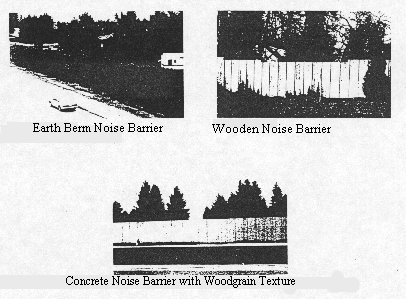
Noise barriers are solid obstructions built between the highway and the homes along the highway. Effective noise barriers can reduce noise levels by 10 to 15 decibels, cutting the loudness of traffic noise in half. Barriers can be formed from earth mounds along the road (usually called earthberms) or from high, vertical Walls. Earthberms have a very natural appearance and are usually attractive. However, an earthberm can require quite a lot of land if it is very high. Walls take less space. They are usually limited to 8 meters in height because of structural and aesthetic reasons. Noise walls can be built out of wood, stucco, concrete, masonry, metal, and other materials. Many attempts are being made to construct noise barriers that are visually pleasing and that blend in with their surroundings.
There are no Federal requirements or FHWA regulations related to the selection of material types to be used in the construction of highway traffic noise barriers. Individual SHAs select the material types to be used when building these barriers. The SHAs normally make this selection based on a number of factors such as aesthetics, durability and maintenance, costs, public comments, etc. The FHWA does not specify the type of material that must be used for noise barrier construction, but the material type that is chosen must meet state specifications which have been approved by the FHWA. The material chosen should be rigid and of sufficient density (approximately 20 kilograms/square meter minimum) to provide a transmission loss of 10 dBA greater than the expected reduction in the noise diffracted over the top of the barrier.
Noise barriers do have limitations. For a noise barrier to work, it must be high enough and long enough to block the view of a road. Noise barriers do very little good for homes on a hillside overlooking a road or for buildings which rise above the barrier. A noise barrier can achieve a 5 dB noise level reduction when it is tall enough to break the line-of-sight from the highway to the receiver and it can achieve an approximate 1.5 dB additional noise level reduction for each meter of height after it breaks the line-of-sight (with a maximum theoretical total reduction of 20 dBA). To avoid undesirable end effects, a good rule-of-thumb is that the barrier should extend 4 times as far in each direction as the distance from the receiver to the barrier. Openings in noise walls for driveway connections or intersecting streets destroy the effectiveness of barriers. In some areas, homes are scattered too far apart to permit noise barriers to be built at a reasonable cost.
-31-
Top
NPC Online Library
NPC Law Library
NPC NoiseNews
NPC Resources
NPC Home
Noise barriers can be quite effective in reducing noise for receptors within approximately 61 meters of a highway. Table 10 summarizes barrier attenuation.
Table 10: Barrier Attenuation
| Reduction in Sound Level | Reduction in Acoustic Energy | Degree of Difficulty To Obtain Reduction |
| 5 dBA | 70% | Simple |
| 10 dBA | 90% | Attainable |
| 15 dBA | 97% | Very Difficult |
| 20 dBA | 99% | Nearly Impossible |
Figure 2: Noise Barrier Examples
-32-
Top
NPC Online Library
NPC Law Library
NPC NoiseNews
NPC Resources
NPC Home
Figure 3: Noise Barrier Shadow Zone

Shadow Effect of Noise Barrier
The lower house is protected by the barrier, but the upper one is not.
Overall, public reaction to highway noise barriers appears to be positive. There is, however, a wide diversity of specific reactions to barriers. Residents adjacent to barriers have stated that conversations in households are easier, sleeping conditions are better, a more relaxing environment is created, windows are opened more often, and yards are used more in the summer. Perceived non-noise benefits include increased privacy, cleaner air, improved view and sense of ruralness, and healthier lawns and shrubs. Negative reactions have included a restriction of view, a feeling of confinement, a loss of air circulation, a loss of sunlight and lighting, and poor maintenance of the barrier. Motorists have sometimes complained of a loss of view or scenic vistas and a feeling of being "walled in" when traveling adjacent to barriers. Most residents near a barrier seem to feel that barriers effectively reduce traffic noise and that the benefits of barriers outweigh the disadvantages of the barriers.
A successful design approach for noise barriers should be multidisciplinary and should include architects/planners, landscape architects, roadway engineers, acoustical engineers, and structural engineers. Noise reduction goals influence acoustical considerations and in conjunction with non-acoustical considerations, such as maintenance, safety, aesthetics, physical construction, cost, and community participation, determine various barrier design options.
-33-
Top
NPC Online Library
NPC Law Library
NPC NoiseNews
NPC Resources
NPC Home
A major consideration in the design of a noise barrier is the visual impact on the adjoining land use. An important concern is the scale relationship between the barrier and activities along the roadway right-of-way. A tall barrier near a low-scale single family detached residential area could have a severe adverse visual effect. In addition, a tall barrier placed close to residences could create detrimental shadows. One solution to the potential problem of scale relationship is to provide staggered horizontal elements to a noise barrier to reduce the visual impact through introduction of landscaping in the foreground. This can also allow for additional sunlight and air movement in the residential area. In general, it is desirable to locate a noise barrier approximately four times its height from residences and to provide landscaping near the barrier to avoid visual dominance.
The visual character of noise barriers should be carefully considered in relationship to their environmental setting. The barriers should reflect the character of their surroundings as much as possible. Where strong architectural elements of adjoining activities occur in close proximity to barrier locations, a relationship of material, surface texture, and color should be explored in the barrier design. In other areas, particularly those near roadway structures or other transportation elements, it may be desirable that proposed noise barriers have a strong visual relationship, either physically or by design concept, to the roadway elements. Aesthetic views and scenic vistas should be preserved to the extent possible. In general, a successful design approach for noise barriers is to utilize a consistent color and surface treatment, with landscaping elements used to soften foreground views of the barrier. It is usually desirable to avoid excessive detail which tends to increase the visual dominance of the barrier.
The psychological effect on the passing motorist must be taken into consideration too. Barriers should be designed differently to fit dense, urban settings or more open suburban or rural areas and should also be designed to avoid monotony for the motorist. At normal roadway speeds, visual perception of noise barriers will tend to be of the overall form of the barrier and its color and surface texture. Due to the scale of barriers, a primary objective to achieve visually pleasing barriers is to avoid a tunnel effect through major variations in barrier form, material type, and surface treatment.
The design approach for noise barriers may vary considerably depending upon roadway design constraints. For example, the design problem both from an acoustic and visual standpoint is substantially different for a straight roadway alignment with narrow right-of-way and little change in vertical grades than for a roadway configuration with a large right-of- way and variations in horizontal and vertical alignments. In the former case, the roadway designer is limited in the options of visual design to minor differences in form, surface treatment, and landscaping. In the latter case, the designer has the opportunity to vary the barrier type, utilize landscaped berming, and employ more extensive approaches to develop a visually pleasing barrier.
-34-
Top
NPC Online Library
NPC Law Library
NPC NoiseNews
NPC Resources
NPC Home
From both a visual and a safety standpoint, noise barriers should not begin or end abruptly. A gradual transition from the ground plane to the desired barrier height can be achieved in several ways. One concept is to begin or terminate the barrier in an earth berm or mound. Other concepts include bending back and sloping the barrier, curving the barrier in a transition form, stepping the barrier down in height, and terminating the barrier in a vegetative planter. The concept of terminating the barrier in a vegetative planter should only be utilized in areas where climatic conditions are conducive to continued vegetative growth and in areas where the planter edges will be protected from potential conflict with roadway traffic.
Graffiti on noise barriers can be a potential problem. A possible solution to this problem is the use of materials which can be readily washed or repainted. Landscaping and plantings near barriers can be used to discourage graffiti as well as to add visual quality.
Highway traffic noise levels are not substantially increased by construction of a noise barrier on the opposite side of a highway from a receiver. If both the direct noise levels and the reflected noise levels are not abated by natural or artificial terrain features, the noise increase is theoretically limited to 3 dBA, due to a doubling of energy from the noise source. In practice, however, not all of the acoustical energy is reflected back to the receiver. Some of the energy is diffracted over the barrier, some is reflected to points other than the receiver, some is scattered by ground coverings (e.g., grass and shrubs), and some is blocked by the vehicles on the highway. Additionally, some of the reflected energy to the receiver is lost due to the longer path that it must travel. Attempts to conclusively measure this reflective increase have never shown an increase of greater than 1-2 dBA, an increase that is not perceptible to the average human ear.
Multiple reflections of noise between two parallel plane surfaces, such as noise barriers or retaining walls on both sides of a highway, can theoretically reduce the effectiveness of individual barriers and contribute to overall noise levels. However, studies of the issue have not indicated problems associated with this type of reflective noise. Any measured increases in noise levels have been less than can be perceived by normal human hearing. Studies have suggested that to avoid a reduction in the performance of parallel reflective noise barriers, the width-to-height ratio of the roadway section to the barriers should be at least 10:1. The width is the distance between the barriers, and the height is the average height of the barriers above the roadway. This means that two parallel barriers 3 meters tall should be at least 30 meters apart.
-35-
Top
NPC Online Library
NPC Law Library
NPC NoiseNews
NPC Resources
NPC Home
To provide standard structural design criteria for the preparation of noise barrier plans and specifications, the American Association of State Highway and Transportation officials (AASHTO) Subcommittee on Bridges and Structures developed "Guide Specifications for Structural Design of Sound Barriers," which was published in 1989 and amended in 1992. These specifications allow for more consistency and less conservatism in barrier design. SHAs are encouraged to apply realistic noise barrier structural design practices and to avoid overly conservative design procedures, especially those related to wind load criteria.
AASHTO has also published a "Guide on Evaluation and Abatement of Traffic Noise: 1993 (code GTN-3)." This report contains a good discussion of the problem of highway traffic noise and ways to address the problem in the United States. It presents a discussion very similar to that found in FHWA literature. Copies of the report are available from AASHTO, 444 North Capitol Street, N.W., Suite 429, Washington, DC, 20001, telephone (202) 624-5800.
5. Flexibility in Decisionmaking
The Federal-aid highway program has always been based on a strong State-Federal partnership. At the core of that partnership is a philosophy of trust and flexibility, and a belief that the States are in the best position to make investment decisions that are based on the needs and priorities of their citizens. The FHWA noise regulations give each SHA flexibility in determining the reasonableness and feasibility of noise abatement and, thus, in balancing the benefits of noise abatement against the overall adverse social, economic, and environmental effects and costs of the noise abatement measures. The SHA must base its determination on the interest of the overall public good, keeping in mind all the elements of the highway program (need, funding, environmental impacts, public involvement, etc.). Congress affirmed and extended the philosophy of partnership, trust, and flexibility in the enactment of ISTEA.
The flexibility in noise abatement decisionmaking is reflected by data indicating that some States have built many noise barriers and some have built none. From 1970 to 1992, forty SHAs and the Commonwealth of Puerto Rico have constructed over 1,486 linear kilometers of barriers at a cost of over $816 million ($875 million in 1992 dollars). Ten States and the District of Columbia have not constructed noise barriers to date.
Vegetation, if it is high enough, wide enough, and dense enough that it cannot be seen through, can decrease highway traffic noise. A 61-meter width of dense vegetation can reduce noise by 10 decibels, which cuts in half the loudness of traffic noise. It is usually impossible, however, to plant enough vegetation along a road to achieve such reductions.
-36-
Top
NPC Online Library
NPC Law Library
NPC NoiseNews
NPC Resources
NPC Home
Roadside vegetation can be planted to create a psychological relief, if not an actual lessening of traffic noise levels. Since a substantial noise reduction cannot be obtained for an extended period of time, the FHWA does not consider the planting of vegetation to be a noise abatement measure. The planting of trees and shrubs provides only psychological benefits and may be provided for visual, privacy, or aesthetic treatment, not noise abatement.

Controlling traffic can sometimes reduce noise problems. For example, trucks can be prohibited from certain streets and roads, or they can be permitted to use certain streets and roads only during daylight hours. Traffic lights can be changed to smooth out the flow of traffic and to eliminate the need for frequent stops and starts. Speed limits can be reduced; however, about a 33 kilometer-per-hour reduction in speed is necessary for a noticeable decrease in noise levels.
Insulating buildings can greatly reduce highway traffic noise, especially when windows are sealed and cracks and other openings are filled. Sometimes noise-absorbing material can be placed in the walls of new buildings during construction. However, insulation can be costly because air conditioning is usually necessary once the windows are sealed. In many parts of the country, highway agencies do not have the authority to insulate buildings; thus, in those States, insulation cannot be included as part of a highway project. Noise insulation is normally limited to public use structures such as schools and hospitals.
Buffer zones are undeveloped, open spaces which border a highway. Buffer zones are created when a highway agency purchases land or development rights, in addition to the normal right-of-way, so that future dwellings cannot be constructed close to the highway. This prevents the possibility of constructing dwellings that would otherwise have an excessive noise level from
-37-
Top
NPC Online Library
NPC Law Library
NPC NoiseNews
NPC Resources
NPC Home
nearby highway traffic. An additional benefit of buffer zones is that they often improve the roadside appearance. However, because of the tremendous amount of land that must be purchased and because in many cases dwellings already border existing roads, creating buffer zones is often not possible.
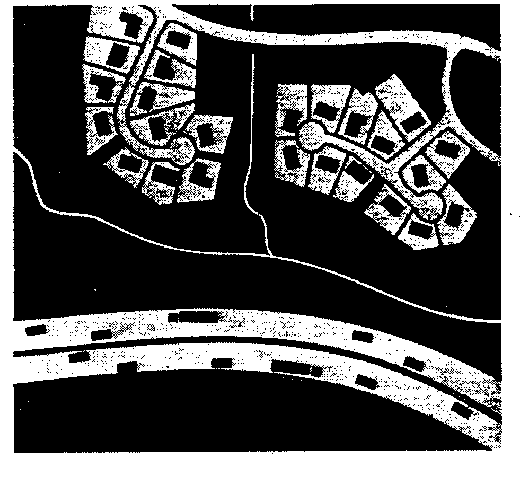
Open space can be left as a buffer zone between residences and a highway,
Pavement is sometimes mentioned as a factor in traffic noise. While it is true that noise levels do vary with changes in pavements and tires, it is not clear that these variations are substantial when compared to the noise from exhausts and engines, especially when there are a large number of trucks on the highway. Additional research is needed to determine to what extent different types of pavements and tires contribute to traffic noise.
It is very difficult to forecast pavement surface condition into the future. Unless definite knowledge is available on the pavement type and condition and its noise generating characteristics, no adjustments should be made for pavement type in the prediction of highway traffic noise levels. Studies have shown open-graded asphalt pavement can initially produce a benefit of 2-4 dBA reduction in noise levels. However, within a short time period (approximately 6-12 months), any noise reduction benefit is lost when the voids fill up and the aggregate becomes polished. The use of specific pavement types or surface textures must not be considered as a noise abatement measure.
-38-
Top
NPC Online Library
NPC Law Library
NPC NoiseNews
NPC Resources
NPC Home
A. Appropriate Level of Highway Traffic Noise Analysis for CE, EA/FONSI, and EIS
Purpose
Highway traffic noise analysts often ask "how much analysis is sufficient?" for a project which will require the use of Federal-aid highway funds. The following discussion is meant to assist in answering that question.
Background
Two different laws control the evaluation of highway traffic noise impacts: NEPA and the Federal-aid Highway Act of 1970, which added Section 109(i) to Title 23 of the U.S. Code of Federal Regulations. They require environmental evaluation of Federal or Federal-aid highway projects, and reasonable and feasible mitigation of identified impacts. The FHWA regulations for mitigation of highway traffic noise in the planning and design of federally-aided highways are contained in 23 CFR 772, "Procedures for Abatement of Highway Traffic Noise and Construction Noise."
The FHWA noise regulations require, during the planning and design of all Type I highway projects, the following: (1) identification of traffic noise impacts; (2) examination of potential mitigation measures; (3) the incorporation of reasonable and feasible noise mitigation measures into the highway project; and (4) coordination with local officials to provide helpful information on compatible land use planning and control. Type I highway projects are those that involve "… construction of a highway on new location or the physical alteration of an existing highway which significantly changes either the horizontal or vertical alignment or increases the number of through-traffic lanes."
The regulations contain noise abatement criteria, which represent the upper limit of acceptable highway traffic noise for different types of land uses and human activities. The regulations do not require that the noise abatement criteria be met in every instance. Rather, they require that every reasonable and feasible effort be made to provide noise mitigation when the noise abatement criteria are approached or exceeded, or when the predicted traffic noise levels substantially exceed the existing noise levels (these two conditions are defined as traffic noise impacts). Compliance with the noise regulations is a prerequisite for the granting of Federal-aid highway funds for construction or reconstruction of a highway.
General guidance related to the format, content, and processing of NEPA and Section 4(f) studies and documents describes the three classes of actions which prescribe the level of documentation required in the NEPA process.
-39-
Top
NPC Online Library
NPC Law Library
NPC NoiseNews
NPC Resources
NPC Home
These classes of actions are the following:
I. Categorical Exclusion (CE)
A Categorical Exclusion is for an action that does not individually or cumulatively have a significant environmental impact.
II. Environmental Assessment/Finding of No Significant Impact (EA/FONSI)
An Environmental Assessment is for an action in which the significance of the environmental impact is not clearly established. A Finding of No Significant Impact is a written document incorporating the EA and any other appropriate environmental documents and in which the Federal Agency agrees that there is no significant impact.
III. Environmental Impact Statement (EIS)
An EIS is for an action that will significantly affect the environment.
Noise Analysis
The level of detail and effort for the traffic noise analysis required on each alternative of a proposed project should be commensurate with the type of project and the impacts and/or issues with which it is associated.
The general content of a traffic noise analysis is discussed in Paragraph 772.9b of 23 CFR 772 (see page 11).
Categorical Exclusion
In considering traffic noise analysis for a CE, it is necessary to make a distinction between two cases. These are (a) CEs which are not Type I projects as defined in 23 CFR 772 (the vast majority of CEs will not be Type I projects) and (b) CEs which are Type I projects.
Projects that are not Type I: No analysis of any kind is required, except for the extremely rare instance in which the project itself is expected to create a noise impact, such projects must be dealt with on a case by case basis in accordance with NEPA.
Projects that are Type I: Noise analysis is required by 23 CFR 772 although none may be necessary to demonstrate NEPA compliance. The analysis should include:
(1) identification of existing activities, developed lands, and undeveloped lands for which development is planned, designed and programmed, which may be affected by noise from the highway;
(2) determination of existing levels by measurement or by use of a simple application of the FHWA model;
-40-
Top
NPC Online Library
NPC Law Library
NPC NoiseNews
NPC Resources
NPC Home
(3) prediction of traffic noise levels using a simple (e.g., nomograph, hand-held calculator, microcomputer, etc.) application of the FHWA Highway Traffic Noise Prediction Model (FHWA model) or, if a more accurate prediction is required, a detailed application of the FHWA model;
(4) determination of traffic noise impacts using the two impact criteria in 23 CFR 772. If no impacts exist, a brief explanation of the basis for no traffic noise impacts should be given (e.g., the project is 90 meters from the nearest receptor).
End of Analysis.
(5) if traffic noise impacts exist, determine if there are any reasonable and feasible measures which will abate the impacts.
As an example of how steps (1), (2), (3), (4) and (5) might be performed, suppose a highway is to be relocated about 150 meters from its existing alignment. There are currently 400 autos/hour, 20 medium trucks/hour, and 32 heavy trucks/ hour in the noisiest hour and all vehicle speeds are about 88 km/h. The general terrain is flat and grassy (i.e., acoustically soft). Future traffic is expected to double. There are nine residences near the relocation alignment, five which are 60 meters from the relocation alignment, and four which are 30 meters from the relocation alignment. Existing noise level near these residences is 60 dBA Leq during PM peak hour.
The SHA uses the following definitions:
"... approach..." means within 1 or 2 dBA or the noise levels shown in TABLE 1 of 23 CFR 772, depending on the specific circumstances (e.g., the amount of human use, the location relative to commercial activity).
"… substantially exceeds existing noise levels..." means an increase of 15 dBA Leq or more.
"… feasible..." means it is structurally and acoustically possible to provide 6 dBA of abatement.
"… reasonable..." means that the SHA believes mitigation is prudent upon consideration of the following conditions:
-41-
Top
NPC Online Library
NPC Law Library
NPC NoiseNews
NPC Resources
NPC Home
3. The relationship between how long the people who would benefit from the abatement have lived in their residences and the date of the final environmental report on the project, if it is on new alignment, or the date of initial construction of the existing highway, if the project is a lane addition.
4. The cost of the abatement (normally such costs should not exceed $20,000 per residence, including any safety and drainage features included specifically due to the abatement measures).
5. The amount of noise reduction provided (normally at least 6 dBA).
6. The extent to which the "build" noise levels exceed the "no build" noise levels.
7. The extent to which the "build" noise levels exceed the existing noise levels.
8. The extent to which the "build" noise levels approach or exceed the NAC.
The above is a fictitious example and must not be construed as containing FHWA recommended definitions. A more thorough discussion of reasonableness and feasibility may be found in the discussion on "Reasonableness and Feasibility (see pp. 50-66)." The particular use of the factors noted above, while consistent with this discussion, is only one example of an application for decisionmaking.
Application of the nomographs to estimate future noise levels at a distance of 15m gives levels of 66, 65 and 71 dBA for autos, medium trucks, and heavy trucks respectively (using future traffic volumes which are double existing volumes) or a combined level of 73 dBA using decibel addition rules. Applying the adjustment for doubling distance from a noise source at a soft site (4.5 decibel decrease for every doubling of distance), the five sites 60 meters from the road would each receive about 64 dBA (PM peak) in the future. Since the existing noise levels are about 60 dBA, this is not a substantial increase. The 64 dBA also does not approach the Noise Abatement Criterion of 67 dBA for a residence. Therefore, given the SHA's definitions of "… substantially exceeds existing noise levels..." and "...approach or exceed...," there is no traffic noise impact at these five sites.
At the four residences closest to the highway, we apply the adjustment for doubling distance from a noise source at a soft site. This results in the conclusion that this site would receive about 68 dBA from the road in the future. Therefore, there is a noise impact at the site and abatement must be considered as follows:
1. Letters have been received from all four households and the mayor expressing strong concern about noise impacts and a desire for a noise barrier.
-42-
Top
NPC Online Library
NPC Law Library
NPC NoiseNews
NPC Resources
NPC Home
2. The local zoning & approval board has agreed in writing to submit future development plans to the SHA for review and comment.
3. The residences preceded the FEIS by many years.
4 & 5. Assume a barrier is the only feasible abatement measure. Assume further that a barrier sufficient to provide 6 dBA of abatement for these residences would be about 270 meters long and 3 meters high. If it would cost $108 per square meter for construction (including safety and drainage work), the total cost would be about $87,000, or about $22,000 per residence.
6. & 7. The increase from both existing conditions and those of the "no build" conditions to the "build" condition is 8 dBA.
8. The noise levels in the "build" condition is 1 dBA higher than the NAC. In addition to these considerations, the mayor has offered to use $3,000 in city funds to landscape the barrier if the SHA agrees to build it.
Given all of the above, the SHA considers abatement to be reasonable at this site even though the cost of the barrier slightly exceeds the SHA's cost/receptor criterion.
End of Analysis
Environmental Assessment/Finding of No Significant Impact
In considering traffic noise analysis for an EA/FONSI, it is desirable to distinguish between three cases. These are (a) EA/FONSIS for projects that are not Type I, (b) EA/FONSIS for projects on low volume roads, and (c) EA/FONSIS for projects on high volume roads. The SHA should define low volume roads. Both low and high volume roads may occur in rural, suburban or urban areas.
Projects that are not Type I: The analysis requires only that an explanation be provided as to whether the project itself will create a noise impact. The few instances where the project will have an impact on noise levels will have to be examined on a case-by-case basis in accordance with NEPA.
Projects that are Type I and are on Low Volume Roads: The analysis requires the same steps as in the case of CES for Type I projects, except chat each alternative under consideration (including the "no build" alternative) requires a separate analysis. This, thus, includes:
(1) identification of existing activities, developed lands, and undeveloped lands for which development is planned, designed and programmed, which may be affected by noise from the highway;
(2) determination of existing levels by measurement or by use of a simple application of the FHWA model;
-43-
Top
NPC Online Library
NPC Law Library
NPC NoiseNews
NPC Resources
NPC Home
(3) prediction of traffic noise levels using a simple application of the FHWA Model;
(4) determination of traffic noise impacts using the two impact criteria in 23 CFR 772. If no impacts exist, a brief explanation of the basis for no traffic noise impacts should be documented;
End of Analysis.
(5) if impacts exist, determine if there are any reasonable and feasible measures which will abate the impacts.
Projects that are Type I and are on High Volume Roads: The analysis should include for each alternative under consideration (including the "no build" alternative):
(l) identification of existing activities, developed lands, and undeveloped lands for which development is planned, designed and programmed, which may be affected by noise from the highway;
(2) determination of existing levels. Measurement is required to verify the presence/absence of non-highway noise sources. Noise measurements should, however, only be necessary at a few areas representing sensitive locations;
(3) prediction of traffic noise levels using either a simple or, if a more accurate prediction is required, a detailed application of the FHWA model;
(4) determination of traffic noise impacts using the two impact criteria in 23 CFR 772. This requires quantification of noise levels. If no impacts exist, a brief explanation of the basis for no traffic noise impacts should be documented;
End of Analysis.
(5) if impacts exist, determine if there are any reasonable and feasible measures which will abate the impacts. Abatement benefits and costs should be quantified to the extent possible. The final EA and accompanying FONSI should indicate which abatement measures are "likely" to be incorporated in the project and identify impacts for which no prudent solution is reasonably available.
Environmental Impact Statements
Projects that are not Type I:
Occasionally, an EIS is done for a project that is not Type I (e.g., a turning lane which brings traffic close to some critical environmental resource). However, these instances are unusual and must be dealt with on a case-by-case in accordance with NEPA.
-44-
Top
NPC Online Library
NPC Law Library
NPC NoiseNews
NPC Resources
NPC Home
Projects that are Type I:
For all Type I projects, noise analysis is required by both NEPA and 23 CFR 772. The analysis should include the following for each alternative under detailed study (including the "no build" alternative):
(1) identification of existing activities, developed lands, and undeveloped lands for which development is planned, designed and programmed, which may be affected by noise from the highway. Each noise sensitive area should be briefly described (residences, businesses, schools, parks, etc.), including information on the number and types of activities which may be affected;
(2) determination of existing levels. Measurement is required to verify the presence/absence of non-highway noise sources. Noise measurements should, however, only be necessary at a few areas representing sensitive locations. In some cases(e.g. highly congested facilities where trucks avoid peak automobile travel periods), both a peak traffic period and a non-peak period noise measurement may be required to verify the worst hour noise levels;
(3) prediction of traffic noise levels using either a simple or, if a more accurate prediction is required, a detailed application of the FHWA model;
(4) determination of traffic noise impacts using the two impact criteria in 23 CFR 772. This requires quantifying the extent of the impact (in decibels) at each sensitive area. Use of a table to compare the predicted levels with the project, the predicted levels without the project, the existing levels, and the noise abatement criteria in 23 CFR 772 is recommended for clarity. If no impacts exist, a brief explanation of the basis for no traffic noise impacts should be given.
End of Analysis.
(5) if impacts exist, determine if there are any reasonable and feasible measures which will abate the impacts. The final EIS should indicate the estimated costs and decibel reductions and should provide a description of the non-barrier abatement measures considered and the reasons why such measures are or are not considered reasonable and feasible. The FEIS should indicate which abatement measures are "likely" to be incorporated in the project and should identify impacts for which no prudent solution is reasonably available.
Design of the Project:
Effort is also needed during the design of the highway project. One of the best engineering practices is the use of multidisciplinary design teams. The incorporation of a highway traffic noise specialist, a landscape architect, a
-45-
Top
NPC Online Library
NPC Law Library
NPC NoiseNews
NPC Resources
NPC Home
maintenance engineer, a highway safety engineer, a hydraulic engineer, and a structural engineer should help produce noise mitigation that is functional, practical and aesthetically pleasing.
PS&E Review:
When a highway project is being reviewed by the FHWA Division office, the environmental document should be used to check for noise mitigation required on the project. Either the CE determination, the FONSI, or the EIS Record of Decision (ROD) should be reviewed to determine the suggested location of noise barriers that have been determined to be reasonable and feasible. Project files should clearly document the reasons why any noise mitigation listed as likely to be implemented in the environmental document has been found not to be reasonable and feasible during the design process.
B. Noise Analysis for Highway Lane Addition Projects
Introduction
The procedures and requirements contained in 23 CFR 772 constitute the noise standards mandated by 23 U.S.C. 109(i). All applicable Federal-aid highway projects must conform to these standards. 23 CFR 772 specifically applies to any project defined as a Type I project -- a proposed Federal or Federal-aid highway project for the construction of a highway on new location or the physical alteration of an existing highway which significantly changes either the horizontal or vertical alignment or increases the number of through-traffic lanes. This discussion is meant to address the FHWA requirements for highway traffic noise analyses related to Federal-aid highway projects which increase the number of through-traffic lanes (hereafter referred to as lane addition projects).
Environmental Processing
If a project is not a Type I project as defined by 23 CFR 772, a noise analysis is not required except in the extremely rare incidence in which the project itself is expected to create a noise impact. Such projects must be dealt with on a case by case basis in accordance with NEPA. The addition of a through-traffic lane is specifically defined as a Type I project and must be analyzed as discussed below. A noise analysis must be done for Type I projects. This analysis may range from a simple screening process utilizing a nomograph to the use of computer software depending on the complexity of the project.
If noise impacts as defined by 23 CFR 772 are not identified, no further analysis is necessary regardless of whether the project is advanced as a CE, EA/FQNSI, or an EIS. However, if noise impacts are identified, additional analysis must be done to determine the significance of the impacts. This determination of significance should be based on consideration of the context and intensity of the impacts as discussed in the council on Environmental Quality (CEQ) Regulation (40 CFR, Part 1508.27). In analyzing highway traffic noise impacts, context should consider the extent of the noise impact. Is the impact on an isolated residence? If noise impacts occur for 50 people, is it
-46-
Top
NPC Online Library
NPC Law Library
NPC NoiseNews
NPC Resources
NPC Home
in a village with a population of 100 in a town of 5,000, or in a city of 50,000? Intensity should consider the noise levels as associated with the impact. Are the predicted absolute noise levels 60 dBA, 70 dBA, or 80 dBA? Is the predicted increase over existing noise levels only 1 or 2 dBA, or is it 10 dBA, 20 dBA, or 30 dBA?
Highway traffic noise is only one area to be considered in the environmental processing of a proposed highway project. The significance of identified traffic noise impacts should be used to help decide whether to process the project with a CE, a Finding of No significant Impact (FONSI), or an EIS. If project impacts, including noise impacts, are deemed not to be significant, the project may be processed with a CE or a FONSI. However, if noise impacts are determined to be significant, the project must be processed with an EIS. 23 CFR 772 states that a traffic noise impact occurs when predicted traffic noise levels substantially exceed the existing noise levels. In documenting the increase in existing noise levels in the environmental processing of a project, care should be taken to avoid the use of the phrase "significant increase" due to the CEQ definition of "significance." The phrase "substantial increase" should always be used to address this type of potential traffic noise impact.
Noise Impacts
Analysis for lane addition projects must follow the procedures outlined in 23 CFR 772. These procedures require: (1) identification of existing activities, (2) determination of existing noise levels, (3) prediction of future traffic noise levels, and (4) determination of traffic noise impacts. Traffic noise impacts occur when the future traffic noise levels approach or exceed the NAC contained in 23 CFR 772 or when the future traffic noise levels substantially exceed the existing noise levels. For lane addition projects, the definition of traffic noise impact in 23 CFR 772 applies to the total noise level of the facility being expanded rather than to just the incremental noise level increase caused by the added lanes.
Many lane addition projects will result in a small, imperceptible increase of future noise levels over existing noise levels (1-3 dBA). This is almost always the case if the lanes are added in the median of an existing multi-lane divided highway or on the outside of an existing highway which is at grade or on fill. A slightly larger, but still small, increase in noise may occur if lanes are added on the outside of an existing highway in cut where additional cutting of sideslopes must be done thereby reducing some of the noise shielding provided by the cut. An exception to this may occur when two-lane highways are expanded to four or more lanes since this modification will substantially increase the traffic capacity of the facility and potentially move the noise source closer to a receiver. Projects of this last type, therefore, may substantially increase the future traffic noise levels over the existing noise levels.
Most traffic noise impacts occur on a lane addition project when future total noise levels near the expanded facility approach or exceed the NAC. In most urban locations where lanes need to be added, existing noise levels along the facility already approach or exceed the NAC. Thus, receptors near the
-47-
Top
NPC Online Library
NPC Law Library
NPC NoiseNews
NPC Resources
NPC Home
facility are experiencing a traffic noise impact even before the new lanes are added and the traffic capacity is increased. Obviously, in this situation, a traffic noise impact will almost certainly occur in the analysis of the lane addition project even though the added lanes do not increase (or substantially increase) future traffic noise levels over the existing noise levels or the future traffic noise levels for the "no-build" alternative. Nevertheless, as defined in 23 CFR 772, a traffic noise impact occurs in this situation, and it must be identified.
From the above discussion, it can be seen that the incremental noise increase caused by the added lanes is usually not the governing factor for identifying a traffic noise impact on a lane addition project. Rather, it is the total noise level for the final facility that usually determines whether or not a traffic noise impact will be identified. This is not to say that the incremental noise increase from the added lanes is unimportant. It in fact is one of the factors that should be considered in determining whether or not a proposed abatement measure is reasonable (see the discussion following in the noise abatement section). For this reason, the traffic noise analysis should include a comparison between the future traffic noise levels for the expanded facility and the "no-build" alternative for the design year.
Noise Abatement
23 CFR 772 also requires that noise abatement measures be considered if a traffic noise impact is identified for a Type I project. Abatement consideration should weigh the abatement benefits, costs, and overall social, economic, and environmental effects. Abatement measures which are found to be reasonable and feasible must be incorporated in the project. If a traffic noise impact is identified for a lane addition project as discussed above, consideration cannot be delayed to a future date or be made part of a Type II program -- an entirely voluntary State program for addressing traffic noise impacts along existing highways.
When considering noise abatement measures, every reasonable effort should be made to obtain a substantial noise reduction (defined by typical State practice to be a reduction of 5 dBA or more), All the abatement measures listed in 23 CFR 772 should be considered. However, for a lane addition project, measures such as traffic management, alteration of alignment, or purchase of land for use as a buffer zone usually either do not provide a substantial noise reduction or are found to be not reasonable and feasible due to cost, right-of-way requirements, or project purpose. Thus, noise barriers are the abatement measure most often associated with the concept of noise abatement on lane addition projects. The consideration of noise abatement must result in a determination of reasonableness and feasibility.
The final determination of reasonableness of noise abatement should be made only after a careful and thorough consideration of a wide range of criteria. The importance that a State places on any one criterion can vary depending on the specific circumstances for a particular project. For example, on a lane addition project where (1) there is little if any difference between the future traffic noise levels for the expanded facility and the future traffic
-48-
Top
NPC Online Library
NPC Law Library
NPC NoiseNews
NPC Resources
NPC Home
noise levels for the "no-build" alternative, and (2) a majority of the development along the highway occurred after initial construction of the highway, the State may decide that these criteria are very important in determining the reasonableness of noise abatement. While the remaining criteria for determining reasonableness (e.g., noise reduction, cost, community support, etc.) under this scenario may individually be less important, they should still be evaluated since, on balance, they may offset the negative aspects of the first two criteria. On another project, for example, where a majority of the adjacent development occurred prior to initial construction of the highway, other criteria, such as noise reduction, cost, etc., may take on added importance.
Summary
A proposed Federal-aid highway project which increases the number of through-traffic lanes is defined by 23 CFR 772 as a Type I project. A noise analysis must be done for this type of project to identify any potential noise impacts as defined 23 CFR 772. The level of analysis required can vary based upon the anticipated noise impacts associated with the project. If noise impacts are identified, the significance of these impacts must be determined. The project must be processed with a CE, a FONSI, or an EIS, as appropriate, based on the significance of noise impacts as well as other environmental impacts. Furthermore, if noise impacts are identified, noise abatement measures must be considered and if they are found to be reasonable and feasible, they must be incorporated into the project. The determination of reasonableness and feasibility should be based on a careful and thorough consideration of many factors and not on any one criterion.
C. Traffic Noise Analysis for Proposed Projects Involving Interchanges, Ramps, or "Lane Widenings"
These types of projects must be classified as Type I projects as defined by 23 CFR 772. The addition of interchanges/ramps/auxiliary lanes/ truck climbing lanes, etc. to existing highways can certainly create significant changes in alignment and/or add through-traffic lanes, and SHAs have a responsibility to ensure that all reasonable and feasible mitigation measures are incorporated into the projects to minimize noise impacts and enhance the surrounding environment to the extent practicable.
Similarly, the addition of high-occupancy vehicle (HOV) lanes to highways are also Type I projects, whether added in the median or on the outside of the existing highway, since they add through-traffic lanes. Traffic noise analysis is required for both sides of the highway, even when HOV lanes are only being added on one side of the highway. Frequently, HOV projects cause little or no change in the existing or future noise environment. However, traffic noise impacts occur since existing noise levels already approach or exceed FHWA noise abatement criteria. In these instances, abatement must be considered and implemented if found to be reasonable and feasible.
-49-
Top
NPC Online Library
NPC Law Library
NPC NoiseNews
NPC Resources
NPC Home
Noise analyses are only required for Federal-aid highway projects that are Type I projects or that create a noise impact as a result of the project. No noise analysis is required for widenings of less than one through-traffic lane width, unless there is a significant change in either the horizontal or vertical alignment or the project itself is expected to create a noise impact. Noise analyses are required in all instances where a through-traffic lane is added to a highway. Two different laws control the evaluation of highway traffic noise impacts: NEPA and the Federal-aid Highway Act of 1970.
The FHWA noise regulations require noise analyses for all Type I projects, defined as projects that involve construction of a highway on new location or the physical alteration of an existing highway which significantly changes either the horizontal or vertical alignment or increases the number of through-traffic lanes. Such analyses must be done to meet FHWA and Title 23 requirements.
If a project does not meet the definition of a Type I project, no noise analysis is required, except for the extremely rare incidence in which the project itself is expected to create a noise impact. A traffic noise impact occurs when the predicted traffic noise levels approach or exceed FHWA's NAC or when the predicted traffic noise levels substantially exceed the existing noise levels. If the project itself is expected to create a noise impact (i.e., the predicted no-build noise levels do not approach or exceed the NAC and the predicted build noise levels either approach or exceed the NAC or substantially exceed the no-build noise levels), a noise analysis must be done to meet the requirements of NEPA.
NOTE: A commonly held viewpoint is that noise analyses should not be necessary for projects that will not change the noise environment - that is, not change the noise levels from those that exist today or not change the noise levels from those that will exist in the future if no project is implemented (e.g., 70 dBA existing and 70 dBA in the future, with or without the project). However, the FHWA noise regulations were developed to specifically address the improvement of situations where existing noise levels are already high (i.e., a traffic noise impact already exists). Thus, noise analyses are required for all Type I projects, even when there is no change in the surrounding noise environment. A parallel can be drawn with highway projects where substandard safety features are upgraded or improved even though the overall goal of the project is not specifically safety-related.
D. Reasonableness and Feasibility of Noise Abatement
Introduction:
It is FHWA'S policy to ensure that all reasonable and feasible mitigation measures are incorporated into projects to minimize noise impacts and enhance the surrounding noise environment to the extent practicable. This commitment to minimize noise impacts and enhance the noise environment must be fulfilled through prudent application of FHWA's noise regulations - 23 CFR 772.
-50-
Top
NPC Online Library
NPC Law Library
NPC NoiseNews
NPC Resources
NPC Home
23 CFR 772 requires that ..." before adoption of a final environmental impact statement or finding of no significant impact, the highway agency shall identify noise abatement measures which are reasonable and feasible and which are likely co be incorporated in the project"... This is frequently the most difficult part of the traffic noise analysis for a proposed highway project, SHA decisionmakers often ask, "What does the phrase reasonable and feasible mean? How should we determine reasonableness and feasibility?" The following discussion is intended to assist in answering these questions.
Background:
Feasibility deals primarily with engineering considerations (e.g., can a barrier be built given the topography of the location; can a substantial noise reduction be achieved given certain access, drainage, safety, or maintenance requirements; are other noise sources present in the area, etc.). Reasonableness is a more subjective criterion than feasibility. It implies that common sense and good judgement were applied in arriving at a decision. Reasonableness should be based on a number of factors not just one criterion.
A determination of reasonableness for abatement measures should include consideration of items such as the following:
(1) Noise Abatement Benefits
(a) Amount of noise reduction provided
(b) Number of people protected
(2) Cost of Abatement
(a) Total cost
(b) Cost variation with degree of benefits provided
(3) Views of the Impacted Residents
(a) Community wishes
(b) Aesthetic impacts (e.g., barrier height, material type, etc.)
(c) Desire for a surrounding view
(4) Absolute Noise Levels
(a) Existing noise levels
(b) Future traffic noise levels
(c) Context and intensity of noise levels (see 40 CFR, Part 1508.27)
(5) Change in Noise Levels
(a) Difference between the future traffic noise levels and the existing noise levels
(b) Difference between the future traffic noise levels for the build alternative and the no-build alternative
-51-
Top
NPC Online Library
NPC Law Library
NPC NoiseNews
NPC Resources
NPC Home
(6) Development Along the Highway
(a) Amount of development that occurred before and after the initial construction of the highway
(b) Type of development (e.g., residential, commercial, mixed, etc.)
(c) Extent to which zoning or land use is changing
(d) Effectiveness of land use controls implemented by local officials to prevent incompatible development
(7) Environmental Impacts of Abatement Construction
(a) Effects on the natural environment
(b) Noise reduction during highway construction
NOTE: Safety, maintenance, and drainage concerns for noise abatement measures should be addressed during preliminary and final project design. These issues should be part of the feasibility determination and can usually be resolved through use of good design practices.
The above listing is not intended to be all encompassing. Rather, it is intended to indicate some of the factors that should be considered in determining the reasonableness of proposed noise abatement measures. Each SHA should develop and utilize its own criteria for determining reasonableness. Reasonableness should be determined through a rational, open process which utilizes a method flexible enough to meet individual situations yet firm enough to be uniformly and consistently applied. The methods used to determine reasonableness should be appropriately influenced by public perception of the problem of highway traffic noise. States where the public is more reactive to the problem of traffic noise should have a more identifiable and comprehensive approach to determining reasonableness. The main point to remember is that the final determination of reasonableness of noise abatement should be made only after a careful and thorough consideration of a wide range of criteria. Lastly, consideration of the criteria should not be rigid -- that is, the specific circumstances for a particular project should be regarded in applying the criteria.
The previous discussion has been general in its approach. The following discussion is meant to be specific and indicate how the criteria or factors should be considered.
The most commonly used noise abatement measure is the construction of a noise barrier. Therefore, the remainder of this discussion will address the consideration of highway traffic noise barriers and discuss how specific factors should be applied in noise barrier decisionmaking. This discussion should be used as a guide by States in establishing criteria and procedures for noise abatement decisionmaking.
-52-
Top
NPC Online Library
NPC Law Library
NPC NoiseNews
NPC Resources
NPC Home
Abatement Decisionmaking:
A highway traffic noise abatement decisionmaker should answer the following questions:
Why are criteria and procedures needed?
Good program management supports the need for highway traffic noise abatement decisionmakLng criteria and procedures. The decision on whether or not to build a noise barrier must not be arbitrary or capricious, and its reasoning should be available and supportable, particularly if the answer is "no" and the affected residents want a barrier to be constructed. The decision must be based upon consistent, uniform application of established criteria and procedures, written policies should be established.
What criteria should be used?
The criteria used for determining reasonableness and feasibility should indicate a broad consideration of conditions that apply in a given location. The criteria should allow identification of the overall benefits, as well as the overall adverse social, economic, and environmental effects, of the noise abatement. Remembering the previous listing of possible criteria, the following criteria might be chosen:
How should these criteria be used in making a decision?
Quantification of each of the criteria allow their use in making a more objective decision. This should allow the decision to be more supportable and more easily explained. The criteria should be responsive to the need to
-53-
Top
NPC Online Library
NPC Law Library
NPC NoiseNews
NPC Resources
NPC Home
provide noise abatement. Conversely, the effects on overall cost to the highway program should be considered when quantifying the criteria. Consequently, the criteria need to be prudently developed. This paper later presents an example of quantification of abatement criteria.
Should criteria and procedures allow "room for judgement?"
Flexibility is an important element of good noise abatement decisionmaking criteria and procedures. The criteria and procedures should be objective enough to be quantifiable, but they should also be flexible enough to allow the decisionmaker to make meaningful judgements on a case-by-case basis for special circumstances.
The criteria and procedures should permit consideration of "gray areas" and should not always be rigidly applied. There may be instances where abatement should be found to be reasonable and feasible even though it is found to fall outside some of the established criteria and procedures, e.g., it costs more than the reasonable cost index (including it protects a fewer number of people), absolute traffic noise levels are lower but increases in existing noise levels are great, changes in noise levels are small but the absolute levels are high, or increases in noise levels since initial development occurred are great.
This discussion will present an example of how a state might quantify the criteria and procedures used in abatement decisionmaking. The definitions and numerical values shown are samples of choices a State might make and should not be construed as FHWA recommendations. Each State should determine its own definitions and values. FHWA comments are provided throughout the example.
EXAMPLE: (THE FOLLOWING TEXT, WITHOUT FHWA COMMENTS, IS AN EXAMPLE OF HOW A STATE MIGHT WRITE CRITERIA AND PROCEDURES)
Feasibility (example of State policy)
Feasibility deals with engineering considerations - that is, can a substantial noise reduction be achieved given the conditions of a specific location. Is the ability to achieve noise reduction limited by: (1) topography; (2) access requirements for driveways, ramps, etc.; (3) the presence of local cross streets; or (4) other noise sources in the area, such as aircraft overflights? All these considerations affect the ability of noise barriers to achieve an actual noise reduction.
It is State policy that construction of a noise barrier is NOT FEASIBLE if a 5 dBA noise reduction cannot be achieved.
FHWA COMMENT 1: A noise barrier which just breaks the line-of-sight from the source to the receiver will achieve a 5 dBA noise reduction. A 5 dBA reduction in noise is readily
-54-
Top
NPC Online Library
NPC Law Library
NPC NoiseNews
NPC Resources
NPC Home
perceptible. Noise barriers which do not achieve at least a 5 dBA reduction in noise are not prudent expenditures of public funds and, therefore, should not be built. When a noise barrier is considered, every reasonable effort should be made to obtain a substantial noise reduction - normally in the range of 5-10 dBA.
Reasonableness (example of State policy):
Reasonableness is a more subjective criterion than feasibility. It implies that common sense and good judgement have been applied in arriving at a decision. Reasonableness should be based on a number of factors, with regard for all of the individual, specific circumstances of a particular project.
It is State policy that the final determination of reasonableness will be made only after a careful and thorough consideration of a wide range of criteria. However, noise barriers will definitely not be built if most affected residents do not want them.
FHWA COMMENT 2: In accordance with FHWA noise regulations, the views of the impacted residents should be a major consideration in determining the reasonableness of abatement. Barriers should definitely not be built if most of the impacted residents do not want them.
The following criteria will normally be used to determine the reasonableness of a noise barrier (NOTE: "Yes" means construction of a barrier is reasonable; "no" means construction of a barrier is not reasonable; "high" and "low" indicate differences in importance):
1. The barrier cost is no more than $25,000/residence.
<$20,000/residence = HIGH YES; $20-25,000/residence = LOW YES;
$25-30,000/residence = LOW NO; >$30,000/residence = HIGH NO
FHWA COMMENT 3: Several points that should be remembered regarding barrier cost are the following:
-55-
Top
NPC Online Library
NPC Law Library
NPC NoiseNews
NPC Resources
NPC Home
The method used to count residences is important and should be clearly delineated. The number of residences should include all dwelling units, e.g., owner-occupied, rental units, mobile homes, etc. When counting residences to determine reasonableness, all "benefitted" residences should be included, regardless of whether or not they were identified as impacted (each unit in a multifamily building should be counted as one residence in determining both impacts and benefits). A State should define the threshold of noise reduction which determines a "benefitted" residence. This threshold should be within the range of 3-5 dBA.(6)
2. "Most" impacted residents want a noise barrier (Get letter from local official or community group stating residents' desire; also, encourage local officials to include highway traffic noise in the land use planning process for added noise abatement consideration).
>80% = HIGH YES; 50-80% - LOW YES; 40-50% = LOW NO; <40% = HIGH NO
FHWA COMMENT 4: The views of the impacted residents should be a major consideration in reaching a decision on abatement measures to be provided. As noted previously, barriers will definitely not be built if most affected residents do not want them. There are, however, no easy methods to determine residents' views or to arrive at a conclusion regarding residents' desire's. Commercial establishments' desire for visibility should be considered, and mixed commercial and residential development should be accommodated. Some SHAs reach a decision after holding public meetings or conducting personal surveys. Others require that local officials or a community group submit a letter stating the residents' wishes.
-56-
Top
NPC Online Library
NPC Law Library
NPC NoiseNews
NPC Resources
NPC Home
3. The housing development predated initial highway construction - "most" impacted homes were built before initial construction of the highway.
>80% = HIGH YES; 50-80% = LOW YES; 30-50% = LOW NO; <30% = HIGH NO
FHWA COMMENT 5: The date of development should be an important part of the determination of reasonableness. It is appropriate to give more consideration to development that predated initial highway construction, whose residents have experienced the greatest traffic noise impacts over the longest period of time. More SHAs should use this criterion in determining reasonableness.
4. The housing development has been in place for at least 10 years - "most" impacted homes have existed for at least 10 years.
>80% = HIGH YES; 50-80% = LOW YES; 30-50% = LOW NO; <30% = HIGH NO
FHWA COMMENT 6: It is acceptable and desirable to give more consideration to residents who have experienced traffic noise impacts for a longer period of time.
5. The future build noise levels are at least 65 dBA.
>70 dBA = HIGH YES; 65-70 dBA = LOW YES;
60-65 dBA = LOW NO; <60 dBA = HIGH NO
FHWA COMMENT 7: It is acceptable to give more consideration to areas with higher absolute traffic noise levels. Absolute noise levels typically found along highways, 60-75 dBA, are usually deemed undesirable and cause complaints from adjacent residences. Normally, the higher the levels, the greater the number of complaints,
6. The future build noise levels are at least 5 dBA greater than the existing noise levels.
>10 dBA = HIGH YES; 5-10 dBA = LOW YES;
3-5 dBA = LOW NO; <3 dBA = HIGH NO
FHWA COMMENT 8: It is acceptable to give more consideration to areas with larger increases over existing noise levels. This gives greater consideration to projects for highways on new location and major reconstruction than it does to projects of smaller magnitude along existing highways.
7. The future build noise levels are at least 3 dBA greater than the future no-build noise levels.
>5 dBA = HIGH YES; 3-5 dBA = LOW YES; <3 dBA = HIGH NO
-57-
Top
NPC Online Library
NPC Law Library
NPC NoiseNews
NPC Resources
NPC Home
FHWA COMMENT 9: It is acceptable to give more consideration to areas where larger changes in traffic noise levels are expected to occur if the project is constructed than if it is not. Again, this gives greater consideration to highway projects with major changes in roadway location or design.
8. Additional input to the determination of reasonableness will be the existing zoning, the potential for land use change in the area, and actions taken or controls put in place by local officials to control incompatible growth and development adjacent to highways.
FHWA COMMENT 10: SHAs sometimes give less consideration for abatement to areas of mixed zoning or development and to areas where existing zoning is expected to change to a less noise-sensitive use. SHAs also sometimes give more consideration to areas that can demonstrate that efforts have been made at the local level to prevent incompatible growth and development along highways. These additional considerations are both acceptable and desirable.
-58-
Top
NPC Online Library
NPC Law Library
NPC NoiseNews
NPC Resources
NPC Home
Now that criteria for reasonableness, and feasibility have been established, the following checklist can be used:
FEASIBILITY
| Yes | No | |
| Can a 5 dBA noise reduction be achieved? | __________ | ___________ |
REASONABLENESS
| REASONABLENESS FACTORS | YES | NO | ||
| High | Low | Low | High | |
| 1. Cost/residence | _________ | __________ | ________ | ________ |
| 2. Residents' desires | _________ | __________ | ________ | ________ |
| 3. Development vs. highway timing | _________ | __________ | ________ | ________ |
| 4. Development existence | _________ | __________ | ________ | ________ |
| 5. Build level 65 dBA | _________ | __________ | ________ | ________ |
| 6. Build level 5 dBA greater than no-build | _________ | __________ | ________ | ________ |
| 7. Build level 3 dBA greater than no-build | _________ | __________ | ________ | ________ |
| 8. ADDITIONAL CONSIDERATIONS:
|
||||
DECISION
| Are barriers feasible? | Yes____ | No____ |
| Are barriers reasonable? | Yes____ | No____ |
| REASONS FOR DECISION:
|
||
-59-
Top
NPC Online Library
NPC Law Library
NPC NoiseNews
NPC Resources
NPC Home
What data are needed to complete the checklist?
To complete the checklist, do the following:
COMMENT 11: As previously stated, residences must include all dwelling units, e.g., owner-occupied, rental units, mobile hones, etc. When counting residences to determine reasonableness, all "benefitted" residences must be included, regardless of whether or not they were identified as impacted (each unit in a multifamily building must be counted as one residence in determining both impacts and benefits).
COMMENT 12: Noise barriers should be designed to achieve a substantial noise reduction. SHAs normally define substantial noise reduction in the range from 5-10 dBA. A decision must also be made to provide this reduction either at a location in the middle of the barrier or at a location near the end of the barrier. NOTE: Remember the rules-of-thumb for trial barrier height and length. Height: 5 dBA for the height to break the line-of-sight between the source and receiver plus 1.5 dBA for each 1 meter in height thereafter. Length: 8 times the distance from the barrier to the receiver.
COMMENT 13: Most SHAs use a value in the range from $160-215/sqmt to estimate barrier cost, for posts and barrier material in place.
* Determine:
The examples in this paper (1) consider residences that receive at least a 3 dBA noise level reduction to be "benefitted," (2) design for an 8 dBA barrier insertion loss (must have at least 5 dBA), and (3) use $160/sqmt to estimate barrier cost.
-60-
Top
NPC Online Library
NPC Law Library
NPC NoiseNews
NPC Resources
NPC Home
Project Examples:
The following examples are meant to illustrate specific applications of the previously discussed reasonableness and feasibility criteria. It should be noted that inclusion of a larger number of criteria in procedures allows for greater flexibility in abatement decisionmaking.
EXAMPLE 1:
The proposed project will widen an existing 4-lane freeway to 8 lanes. Ten single-family homes are impacted in a stable, residential neighborhood. Seven of the homes were constructed prior to 1955; the other three were built between 1970 and 1983. Typical noise levels for residences in rural areas, such as this was prior to 1955, are 45-50 dBA. A 2-lane highway was originally constructed in the area in 1965 and was later widened to 4 lanes in 1975. The existing noise level in the area is 66 dBA. A future build noise level of 68 dBA and a future no-build noise level of 68 dBA are predicted for the design year (2011). A 4 1/4 meter high noise barrier will reduce noise for the ten homes by 8 dBA and will cost $290,000. All the residents want a noise barrier to be constructed. Highway traffic noise is not currently considered in local land use planning.
See the checklist for Example 1 on page 63.
Example 1 illustrates a typical widening of an existing freeway. Existing noise levels change very little, and there is no difference between future build and no-build noise levels. The barrier cost per residence exceeds the established cost index. SHAs frequently use these factors alone to support a "no" decision for noise barriers. However, often the affected areas are stable, well established neighborhoods where traffic noise has increased noise levels substantially over time, as in this example. These factors, along with the slight exceedance of the cost index, could result in a "yes" decision. This example illustrates a flexible application of reasonableness criteria for a "gray area," as shown by the checklist.
EXAMPLE 2:
The proposed project will widen an existing 2-lane highway to 4 lanes. Ten single-family homes are impacted in area with mixed residential and commercial zoning, which has not changed in the last two decades. Two of the homes were constructed in the 1920's, two between 1950 and 1960, and six since 1987. A gravel roadway was originally paved in 1948, and several reconstructions of the paved highway have occurred since then. The existing noise level in the area is 69 dBA. A future build noise level of 73 dBA and a future no-build noise level of 71 dBA are predicted for the design year (201l). A 3 1/2 meter high noise barrier will reduce noise for the ten homes by 6 dBA and will cost $240,000. All the residents want a noise barrier to be constructed.
See the checklist for Example 2 on page 64.
Example 2 illustrates another "gray area" using the checklist. The affected residents want a barrier, the cost is reasonable, and the future build noise level is 73 dBA. Many SHAs would make a decision of "yes" for a noise barrier, and this is acceptable. However, since most development in the area is recent, the difference between future build and no-build noise levels is slight, and the area has mixed zoning, the answer could also be "no." Again, this example illustrates flexibility in the decisionmaking process.
-61-
Top
NPC Online Library
NPC Law Library
NPC NoiseNews
NPC Resources
NPC Home
EXAMPLE 3:
The proposed porject will construct a 4-lane highway on new location. Eleven single-family homes are impacted in a residential neighborhood. All of the homes were built in the 1960's except one that has been constructed in the last year. The existing noise level in the area is 45 dBA. A future build noise level of 72 dBA and a future no-build noise level of 45 dBA are predicted for the design year (2011). A 3 meter high noise barrier will reduce noise for ten of the homes by 7 dBA (the eleventh home will recieve 2 dBA reduction) and will cost $385,000. Residents in seven of the homes want a barrier; residents in the other four do not.
See the checklist for Example 3 on page 65.
Example 3 illustrates abatement decisionmaking for a highway on new location. The project has a large increase in existing noise levels, as well as a large difference between future build and no-build noise levels. Noise levels will be almost eight times as loud as they are now - there will be a change in the noise environment. Most SHAs would say the answer for abatement is "no," solely because the barrier cost exceeds the reasonable cost index by 50%. However, while being important, cost should not always be the overriding factor in abatement decisionmaking. The extenuating circumstance for this project clearly point to strong consideration of a "yes" answer.
-62-
Top
NPC Online Library
NPC Law Library
NPC NoiseNews
NPC Resources
NPC Home
EXAMPLE 1 (see discussion on page 61):
| FEASIBILITY | Yes | No |
| Can a 5 dBA noise reduction be achieved? | __X__ | _____ |
| REASONABLENESS FACTORS | YES | NO | ||
| High | Low | Low | High | |
| 1. Cost/residence | _____ | _____ | __X__ | _____ |
| 2. Residents' desires | __X__ | _____ | _____ | _____ |
| 3. Development vs. highway timing | _____ | __X__ | _____ | _____ |
| 4. Development existence | __X__ | _____ | _____ | _____ |
| 5. Build level 65 dBA | _____ | __X__ | _____ | _____ |
| 6. Build level 5 dBA greater than existing | _____ | _____ | _____ | __X__ |
| 7. Build level 3 dBA greater than no-build | _____ | _____ | _____ | __X__ |
| 8. ADDITIONAL CONSIDERATIONS:
Traffic noise not currently considered in local land use planning activities. 7 of 10 homes built before highway. Noise in area has increased by 20 dBA over time. Area will have gone from no highway to an 8-lane freeway. |
||||
| DECISION | ||
| Are barriers feasible? | Yes __X__ | No _____ |
| Are barriers reasonable? | Yes __X__ | No _____ |
| REASONS FOR DECISION: | More importance given to the residents' desire for a barrier, the existence of 70% of the homes prior to the highway, a 20 dBA increase in noise levels over time, and going from no highway to an 8-lane freeway. |
-63-
Top
NPC Online Library
NPC Law Library
NPC NoiseNews
NPC Resources
NPC Home
EXAMPLE 2 (see discussion on page 61):
| FEASIBILITY | Yes | No |
| Can a 5 dBA noise reduction be achieved? | __X__ | _____ |
| REASONABLENESS FACTORS | YES | NO | ||
| High | Low | Low | High | |
| 1. Cost/residence | ____ | __X__ | _____ | _____ |
| 2. Residents' desires | __X__ | _____ | _____ | _____ |
| 3. Development vs. highway timing | _____ | _____ | _____ | __X__ |
| 4. Development existence | _____ | _____ | __X__ | _____ |
| 5. Build level 65 dBA | __X__ | _____ | _____ | _____ |
| 6. Build level 5 dBA greater than existing | _____ | _____ | __X__ | _____ |
| 7. Build level 3 dBA greater than no-build | _____ | _____ | _____ | __X__ |
| 8. ADDITIONAL CONSIDERATIONS:
Area has mixed commercial and residential zoning. |
||||
| DECISION | ||
| Are barriers feasible? | Yes __X__ | No _____ |
| Are barriers reasonable? | Yes _____ | No __X__ |
| REASONS FOR DECISION: | More importance given to the recent development in the area (6 homes since 1987), only a 2 dBA increase in build over no-build noise levels, and mixed zoning in the area. |
-64-
Top
NPC Online Library
NPC Law Library
NPC NoiseNews
NPC Resources
NPC Home
EXAMPLE 3 (see discussion on page 62):
| FEASIBILITY | Yes | No |
| Can a 5 dBA noise reduction be achieved? | __X__ | _____ |
| REASONABLENESS FACTORS | YES | NO | ||
| High | Low | Low | High | |
| 1. Cost/residence | _____ | _____ | _____ | __X__ |
| 2. Residents' desires | _____ | __X__ | _____ | _____ |
| 3. Development vs. highway timing | _____ | _____ | _____ | _____ |
| 4. Development existence | __X__ | _____ | _____ | _____ |
| 5. Build level 65 dBA | __X__ | _____ | _____ | _____ |
| 6. Build level 5 dBA greater than existing | __X__ | _____ | _____ | _____ |
| 7. Build level 3 dBA greater than no-build | __X__ | _____ | _____ | _____ |
| 8. ADDITIONAL CONSIDERATIONS:
This will be a 4-lane highway on new location in an established neighborhood. Noise levels will increase by 27 dBA over existing levels. The future build noise levels will be 27 dBA greater than the future no-build levels. Most residents want a barrier. |
||||
| DECISION | ||
| Are barriers feasible? | Yes __X__ | No _____ |
| Are barriers reasonable? | Yes __X__ | No _____ |
| REASONS FOR DECISION: | More importance given to a 4-lane highway on new location, a 27 dBA increase over existing noise levels, a 27 dBA increase in build over no-build noise levels, and most residents' desire for a barrier. |
-65-
Top
NPC Online Library
NPC Law Library
NPC NoiseNews
NPC Resources
NPC Home
One of the most difficult parts of traffic noise analysis is determining the reasonableness and feasibility of abatement. FHWA has previously issued guidance containing a general discussion on the determination of reasonableness and feasibility. The guidance recommended consideration of a wide range of criteria and listed possible criteria. However, the guidance did not address the details of how to consider the criteria. This discussion has addressed the details of determining the reasonableness and feasibility of noise abatement, specific examples have been shown. The date that development occurred along highways should be an important criterion in determining the reasonableness of noise abatement.
Good program management supports the need for highway traffic noise abatement decisionmaking policies. Abatement decisionmaking must not be arbitrary and capricious. The reasoning for decisions should be available and supportable. Objective, quantifiable decisionmaking criteria can aid in promoting better public understanding and acceptance of decisions.
Inclusion of a wide range of reasonableness criteria provides greater flexibility in abatement decisionmaking, such flexibility is essential to allow for consideration of special circumstances in individual cases. Policies should not be rigidly applied.
E. Type II Projects for Highway Traffic Noise Abatement
Purpose
Highway traffic noise is a major contributor to overall transportation noise. It emanates from newly construcced highways and from highways that are already in place. People often ask what can be done to deal with highway craffic noise problems along existing highways. The following discussion outlines measures that can be taken in the Federal-aid highway program to abate existing traffic noise problems. The discussion highlights the prioritization process for highway projects that provide this abatement and presents information on the methods used by selected states to accomplish the prioritization.
Background
The Federal Aid Highway Act of 1970 included a provision which required the FHWA to develop noise standards for use in the planning and design of new highway projects. These standards were promulgated, in the form of a regulation, by FHWA on February 8, 1973. Later, because of pressure received from a number of States, this provision was amended by the Federal Aid Highway Act of 1973 to permit the control of traffic noise on previously constructed highways. As a result, FHWA'S noise regulation, currently contained in 23 CFR 772, was revised to provide for Federal participation in noise abatement projects along existing highways. The regulation defines these types of projects as Type II projects (these projects are also often referred to as retrofit projects). The development and implementation of Type II
-66-
Top
NPC Online Library
NPC Law Library
NPC NoiseNews
NPC Resources
NPC Home
projects are not mandatory requirements of Federal law or regulation. A program to implement such projects results from a strictly optional decision by a State to provide noise abatement along existing highways.
FHWA Noise Regulations
The FHWA noise regulations indicate that Type II projects will not normally be approved for those activities and land uses which come into existence after May l4, 1976, because the FHWA publicly stated at that time that local governments must help control highway traffic noise impacts through noise compatible land use planning and zoning. The intent of this provision is to establish a date to determine Federal-aid eligibility for Type II projects based upon time of land development. The exact date for eligibility is not specifically defined in the regulation. Each SHA and accompanying FHWA Division Office is encouraged to establish a mutually acceptable specific date to determine Federal-aid eligibility for Type II projects and then consistently apply this date to all Type II abatement locations. One possible date for consideration that has evolved is the date of issuance of a building permit. Other dates used by States to determine eligibility include the date of recording of the plat plan and the date of actual construction. While there may be a wide variation in time for the dates that are used, any of the dates are acceptable to determine the existence of development, if they are agreeable to both the SHA and the FHWA Division Office and are consistently applied.
Noise abatement measures may be approved for activities and land uses that come into existence after May l4, 1976, provided that local authorities have taken measures to exercise land use control over the remaining undeveloped lands adjacent to highways in the local jurisdiction to prevent further development of incompatible activities. These measures may include any of the noise abatement measures contained in the FHWA publication, "The Audible Landscape."
An SHA voluntarily requesting Federal-aid participation for eligible Type II projects is required to perform a noise analysis of sufficient scope to: (1) identify that a traffic noise impact exists, (2) demonstrate that the proposed noise abatement measures will reduce the traffic noise impact, and (3) determine that the overall noise abatement benefits outweigh the overall adverse social, economic, and environmental effects and the costs of the noise abatement measures. While the first two criteria are relatively easy to quantify, the third criterion, along with cost considerations, becomes more difficult to quantify. The FHWA has not developed or specified any one method of analysis for Type II projects. Instead, States are encouraged to use good judgement in the consideration of all relevant factors, both beneficial and adverse. The FHWA does not expect all factors to be quantified, but does expect a decision based on the social, economic, and environmental benefits and disbenefits of the noise abatement measures.
-67-
Top
NPC Online Library
NPC Law Library
NPC NoiseNews
NPC Resources
NPC Home
Projects for Type II noise abatement may include the following measures: (1) traffic management measures (e.g., traffic control devices and signing for prohibition of certain vehicle types, time-use restrictions for certain vehicle types, modified speed limits, and exclusive lane designations), (2) alteration of horizontal and vertical alignments, (3) construction of noise barriers, and (4) noise insulation of public use or nonprofit institutional structures. The construction of noise barriers is the mitigation measure most often associated with the concept of traffic noise abatement.
Type II Barrier States
Since the Type II noise program is optional, only 17 States have elected to participate in this program. The main reason for this is that Type II abatement projects must compete with all other construction needs of the States, and highway construction needs normally far exceed available funds. As of 1992, a listing of highway traffic noise barriers built by SHAs indicated that the 17 states constructed over 346 kilometers of Type II noise barriers at a cost of over $240 million in 1992 dollars. The following table summarizes the listing:
Table 11: Type II Noise Barrier Construction By State By Total Barrier Length (1970-1992)
| State | Linear Length in Kilometers | Actual Cost (Millions) | Cost in 1992 Dollars (Millions) |
| California | 182.6 | $90.4 | $105.1 |
| Minnesota | 42.2 | 17.7 | 28.3 |
| Michigan | 28.6 | 16.2 | 18.5 |
| Maryland | 24.7 | 37.0 | 37.7 |
| Colorado | 21.7 | 4.9 | 5.4 |
| New York | 15.1 | 13.6 | 13.6 |
| Wisconsin | 10.4 | 11.6 | 11.8 |
| New Jersey | 6.9 | 11.4 | 11.5 |
| Connecticut | 5.1 | 2.1 | 2.8 |
| Oregon | 2.6 | 1.3 | 1.3 |
| Washington | 2.0 | 1.6 | 1.6 |
| Louisiana | 1.5 | 0.2 | 0.3 |
| Iowa | 1.1 | 0.4 | 0.5 |
| Georgia | 0.9 | 0.5 | 0.5 |
| Massachusetts | 0.4 | 0.7 | 0.8 |
| Florida | 0.3 | 0.1 | 0.1 |
| Ohio | 0.3 | 0.2 | 0.2 |
| ______ | ______ | ______ | |
| Total | 346.4 | $209.9 | $240.0 |
-68-
Top
NPC Online Library
NPC Law Library
NPC NoiseNews
NPC Resources
NPC Home
Priority Rating Systems
General Discussion
The SHAs have great flexibility in developing and structuring a Type II program. One program management tool that SHAs have found to be essential is a priority rating system. Such a system enables them to uniformly and equitably handle traffic noise impacts and complaints along existing highways while providing a rational basis for an important part of a very tough decisionmaking process. The FHWA strongly encourages the development and use of a priority rating system to indicate the relative priority of individual projects with other potential Type II projects in a State. Factors that may be considered include:
(1) applicable State law,
(2) type of development to be protected,
(3) magnitude of the traffic noise impact,
(4) cost - benefits,
(5) population density of the affected area,
(6) day-night use of the property,
(7) feasibility and practicability of noise abatement at the site,
(8) availability of funds,
(9) existing noise levels,
(10) achievable noise reduction,
(11) intrusiveness of highway noise,
(12) public's attitude,
(13) local government's efforts to control land use adjacent to the highway,
(14) date of construction of adjoining development,
(15) increase in traffic noise since the development was constructed,
(16) local noise ordinances,
(17) feasibility of abating the noise with traffic control measures.
These factors are not meant to be all inclusive, but rather are meant to indicate that implementation of a Type II program should be based upon a wide range of varying considerations. A number of States with existing Type II programs have already developed specific methodologies for determining relative priorities among projects. California, which has built over 50% of existing Type II barriers, uses the following formula:
California: Priority Index =
___Achievable Reduction (db) x (Noise Level - 67) x Number of Living Units____
Cost ($1,000)
Michigan uses a similar formula:
Michigan: Priority Factor =
___Achievable Reduction x Number of Living Units Protected____
Barrier Cost
-69-
Top
NPC Online Library
NPC Law Library
NPC NoiseNews
NPC Resources
NPC Home
A more complete discussion of the above formulas is included in the next section of this discussion. Connecticut and New Jersey have procedures that are representative of more complex priority rating systems. Whether relatively simple or more complex, the FHWA strongly encourages the development and use of procedures such as these for effective management of a Type II program.
Selected State Examples
Three States have been selected for a more detailed discussion of their priority rating systems. These States, which include California, Michigan, and Massachusetts have been selected because of their range of experience levels with the Type II noise program. California, as mentioned above, leads the country in the construction of Type II projects. Michigan also has many years of experience with a Type II noise program, although its program is considerably smaller than California's program. Massachusetts on the other hand is a good example of a State that has just established a Type II noise program.
California
NOTE: This California information was furnished in 1988.
The California Department of Transportation (CALTRANS) initiated its Type II noise program, which it refers to as the Community Noise Abatement Program, in 1974. This program provides for the construction of noise barriers adjacent to residential areas where: (1) the noise from an adjacent existing freeway exceeds the FHWA noise abatement criteria for residential land use (67 dBA Leq), and (2) the residential area existed prior to the construction of the adjacent freeway or prior to an alteration of the freeway which caused a substantial increase in noise levels (3 dBA).
In 1978, the State legislature passed a provision that required CALTRANS to develop and implement a priority ranking system for the installation of noise barriers along existing freeways in the California Freeway and Expressway System. In addition, this legislation required CALTRANS, when all freeways had been ranked in priority order and consistent with available funding, to recommend a program of construction of noise attenuation barriers beginning with the highest priority. Although this legislation required CALTRANS to establish a priority ranking of projects, it did not require a commitment of funds to the program, leaving that decision to the California Transportation Commission.
-70-
Top
NPC Online Library
NPC Law Library
NPC NoiseNews
NPC Resources
NPC Home
As a result, CALTRANS inventoried all the residential areas meeting the above noise level exposure and time of development criteria, and then segregated them into logical project limits. The individual projects were then assigned a priority index in accordance with the following formula:
PI = __AR X (NL - 67) X LU__
COST ($1000)
Where:
PI = Priority Index
AR = Achievable Reduction*
NL = Measured Noise Levels, Leq
LU = Number of Living Units
* In order to be considered cost effective, the achievable reduction must equal or exceed 5 dBA.
Although CALTRANS' Type II Noise Program was initiated in 1974, it wasn't until the 1976-77 fiscal year that any substantial amount of funds were devoted to this program because of funding constraints. Current cost of this program is averaging about $1.7 million per kilometer, including the cost of landscaping and irrigation system modifications, incidental paving and the incorporation of safety shaped barriers where needed.
CALTRANS' current inventory of unconstructed projects shows a need of approximately $190 million (in 1987 dollars) for Type II projects. The current State Program includes $12.2 million for the Type II program for the 5 year period from the 1987-88 thru 1991-92 Fiscal Years, or just over $2.4 million annually. This is a substantial reduction compared to prior years when as much as $20 million annually was budgeted to the Type II program in California.
A unique feature of the CALTRANS Type II program is that State legislation allows cities or counties to construct noise barriers (to State standards) which are included in the State's Program, ahead of the time that such barriers reach a high enough priority for State funding. When the funding priority is reached, CALTRANS is then required to reimburse the city or county, without interest, for the cost of such barrier constructed. To date, three cities have constructed noise barriers along State Highways under this provision of the Code.
-71-
Top
NPC Online Library
NPC Law Library
NPC NoiseNews
NPC Resources
NPC Home
CALTRANS generally initiates Type II projects by holding public informational type meetings with the residents affected. These meetings are held to explain the proposed project, such as wall locations, proposed wall heights, attenuation expected, and other potential benefits and disadvantages. A primary purpose of these meetings is to receive public comments on the perception of the project impact on the community and the people's feelings on proceeding with the project. Generally, CALTRANS' program has been accepted by the public and CALTRANS has been encouraged to construct the projects as soon as possible.
Michigan
The Michigan Department of Transportation (MDOT) constructed its first Type II noise barrier in 1973 as a result of public complaints and a realization that there were existing highway traffic noise problems. The decision to build the barrier was facilitated by the facts that sufficient right-of-way for a barrier already existed and that Federal-aid was available to participate in the cost. The MDOT had confidence that necessary resources to administer a Type II abatement program could be found if the program became long term.
Subsequent to construction of the first noise barrier, the MDOT was able to identify approximately l100 potential Type II abatement sites along 560 kilometers of limited access highways using a staff of three persons for four months. The staff completed the inventory by visually identifying areas with potential traffic noise problems and then calculating noise levels using existing traffic and site data.
The MDOT has used several different formulas to prioritize Type II projects in the past. Experience has led to current use of the following formula:
Priority Factor = __(Achievable Reduction) x (Number of Living Units Protected)__
Barrier cost
Where:
Achievable Reduction - is the reduction at the first row of residences, halfway between the residence and the right-of-way line, based on a measurement of existing noise levels and calculations of the expected attenuation from a barrier of reasonable height.
Number of Living Units Protected - is the number of living units whose noise level will be reduced to or below 67 dBA Leq(h) after the barrier is built, usually including units constructed after the freeway as well as units constructed before the freeway. The MDOT reserves the right to exclude or lessen the consideration of units constructed after the freeway if they comprise the majority of protected units.
Barrier cost - is a value of $820 per linear meter multiplied by the MDOT percentage share of a specific project, state law requires municipal governments of over 35,000 population to contribute between 1 and l 1/2% of
-72-
Top
NPC Online Library
NPC Law Library
NPC NoiseNews
NPC Resources
NPC Home
the cost of noise barriers (as well as for bridges, pavement, etc.). The MDOT also requires the local government to pay the entire cost of highway project items deemed to be "optional" by the MDOT (this has not yet been applied to a Type II project).
The MDOT has guidelines containing .projcedures for public involvement in the Type II program. While the procedures outline formal contacts, meetings, presentations, and a public hearing, it has been found that performing all of the procedures is often not necessary. The MDOT has constructed many Type I noise barriers (barriers that are part of a new highway construction project), and in areas near those where noise barriers have previously been built, public involvement is mostly informal yet successful. Before proceeding to final design for a Type II project, the MDOT requires that local officials submit an adopted resolution stating their desire for a noise barrier. Local officials are also required to adopt a land use plan that controls development to lessen future noise problems. These two requirements add local involvement in dealing with traffic noise problems.
While no special funds have been designated to provide Type II noise abatement in Michigan. The MDOT has consistently chosen to spend existing highway funds for this purpose. Special efforts have been made through planning and programming to develop a program of projects reasonably in line with projected revenues. This has been a very difficult task since there are so many identified traffic noise problem areas along Michigan's freeways (there are approximately 500 sites that have been identified with noise levels above 72 dBA Leq(h)), only one Type II project has been implemented as a result of the political process rather than through prioritization. Approximately 1 1/3 person years of noise staff time is required annually for Type II program activities. This includes complaint investigation and response, noise measurements, acoustic design of noise barriers, project development, contract monitoring, etc.
Massachusetts
Massachusetts built one Type II noise barrier in 1985 as a result of strong public complaints and the political process, Subsequently, a decision was wade to develop an ongoing Type II program to respond to continuing public and political concern for highway traffic noise problems.
The Massachusetts Department of Public Works (MDPV) first developed a policy statement which outlined the MDPV'S decision to apply the Type II program to all Interstate routes in Massachusetts under MDPV jurisdiction. These routes totaled 659 kilometers in length. Prior to conducting an inventory of traffic noise problem areas, the MDPV examined the effectiveness of 18 Type I noise barriers previously built along Interstate routes under MDPV control. This examination of existing noise barriers was used later to aid in establishing a Type II prioritization process. The MDPV then proceeded to follow the procedures outlined in its Type II policy statement. Noise levels were computed along the Interstate right-of-way lines using links from the "1987 Estimate of the Cost of Completing the National System of Interstate and Defense Highways in the Commonwealth of Massachusetts." Links 75 dBA Leq(h) or louder (approximately half the total kilometers) were retained for further
-73-
Top
NPC Online Library
NPC Law Library
NPC NoiseNews
NPC Resources
NPC Home
consideration. Initially, the Massachusetts Type II program included only the loudest third of the 75 dBA or louder links - these were 79 dBA leq(h) or louder at the right-of-way line for approximately 128 kilometers of Interstate highways.
Next, all noise-sensitive land uses within 150 meters of the 75 dBA or louder links were identified. This was a very labor-intensive activity since land records for each town and city were reviewed to determine the date that a particular land use originated.
Actual noise barrier locations were identified next through field surveillance along the 128 kilometers of 79 dBA or louder Interstate highways. Areas with no noise-sensitive activities and areas with fewer than six residences were excluded in accordance with MDPW policy. The acoustical feasibility of noise barriers at problem locations along both sides of the highways was reviewed. Locations where it was acoustically impossible to achieve a 10 decibel noise reduction due to terrain conditions and locations where the Interstate highway noise did not predominate over local roadway noise by 5 decibels or more were eliminated from further consideration. The feasibility review resulted in a listing of 53 noise barriers that were deemed to be "acoustically feasible." The barriers were sized to obtain at least a 10 decibel noise reduction for at least one noise-sensitive activity. Only first-floor dwelling units were taken into account, and barrier heights were constrained to between 3.6 and 9.1 meters. The listing showed 53 barriers that ranged in height from 3.6 to 7.9 meters, that ranged in length from 366 to 2408 meters and that protected between 1 and 266 activities each.
The listing of 53 barriers was lastly prioritized using the following method:
Primary Rating:
This is a measure of the existing traffic noise impact summed over all noise-sensitive receivers for each noise barrier. The rating consists of a summation of "Priority Points" for each barrier, computed as follows:
* 5 points accrue for each year of noise impact. If the receivers preceded the highway, the impact started when the highway was opened to traffic and continues up to the present. If the highway preceded the receivers, the impact started when the receivers arrived and continues up to the present. The arrival of receivers is defined as the date that the oldest noise-sensitive activity originated in the area of the barrier.
* For residences of all types, the following points accrue:
-74-
Top
NPC Online Library
NPC Law Library
NPC NoiseNews
NPC Resources
NPC Home
* For places of worship, the following points accrue:
* For schools, hospitals, nursing homes, libraries, or recreational areas of all types, the following points accrue:
Supplemental Rating:
This is a measure of the average cost-effectiveness of protecting the activities in the area of each noise barrier. It is computed as the barrier's estimated 1987 cost divided by the noise reduction and the number of protected units. It is abbreviated as the "Cost/Reduction/Unit Racing" and has units of $/dB/unit.
The barrier listing was prioritized from highest to lowest according to the Primary Racing procedure. Where Primary Racing ties existed, the listing was prioritized according to the Supplemental Racing, where lower was better.
The MDPW does not have a set amount of funds that is to be budgeted annually for Type II noise abatement. Design is to proceed on the top two or three priority Type II noise barriers, and the programming and implementation of projects will follow. Additional work must be accomplished to make the Type II program ongoing, but the MDPW has developed a comprehensive, rational, well-documented beginning for aiding in the management of such a program.
Summary
The FHWA noise regulation allows a State to spend Federal-aid highway funds for projects to provide noise abatement along existing highways. These projects are called Type II projects and are implemented strictly at the option of a State - they are not mandatory requirements. The noise regulation provides States with considerable flexibility for designing their own Type II traffic noise abatement program, including the very important task of individual project prioritization. The regulation requires that the overall noise abatement benefits outweigh the overall adverse social, economic, and environmental effects and the costs of the noise abatement measures. This determination relies on good judgement by the States, rather than prescriptive Federal procedures since the individual States are in the best position to make these determinations on a local basis.
As of 1992, 17 States had elected to implement Type II noise abatement programs. This discussion has stressed the need for a sound, rational approach to determining individual Type II project priorities for effective
-75-
Top
NPC Online Library
NPC Law Library
NPC NoiseNews
NPC Resources
NPC Home
management of Type II programs. Information has been presented for three State Type II programs. California has constructed the most Type II projects, Michigan has a long-standing Type II program, and Massachusetts is currently implementing such a program.
SHAs must identify when the public is officially notified of the adoption of the location of a proposed highway project. This date establishes the "date of public knowledge" and determines the date when the Federal/state governments are no longer responsible for providing noise abatement for new development which occurs adjacent to the proposed highway project. The FHWA has previously left entirely to a State the determination of the "date of public knowledge." However, from now on, the "date of public knowledge" cannot precede the date of approval of CEs, FONSIs, or RODs.(7)
G. Highway Traffic-Induced Vibration
There are no Federal requirements directed specifically to traffic-induced vibration. All studies the SHAs have done to assess the impact of operational traffic-induced vibrations have shown that both measured and predicted vibration levels are less than any known criteria for structural damage to buildings. In fact, normal living activities (e.g., closing doors, walking across floors, operating appliances) within a building have been shown to create greater levels of vibration than highway traffic. Vibration concerns should be addressed on a case-by-case basis as deemed appropriate.
H. Written State Noise Policies
All SHAs must adopt written statewide noise policies that have been approved by FHWA. Regional Administrators are delegated the authority to approve the State policies; this authority may be redelegated to Division Administrators. The policies must demonstrate substantial compliance with the noise regulations, 23 Code of Federal Regulations Part 772, as well as with the reissued noise policies and guidance. Copies of draft policies should be sent to HEP-40 for review and comment; one copy of each approved policy should also be sent to HEP-40.
-76-
Top
NPC Online Library
NPC Law Library
NPC NoiseNews
NPC Resources
NPC Home
| 1. | noise standards...................................................... | 6 |
| 2. | traffic noise impacts.............................................. | 7-10, 26-27 |
| 3. | planned, designed, and programmed..................... | 11-12 |
| 4. | noise analysis locations | |
| exterior areas....................................................... | 12, 24 | |
| frequent human use .............................................. | 12, 24-25 | |
| interior areas........................................................ | 12-13, 24-25 | |
| 5. | substantial noise reduction.................................... | 9, 13-14, 60 |
| 6. | reasonable and feasible......................................... | 14-15, 50-66 |
| 7. | views of the impacted residents............................ | 15, 51, 55-56 |
| 8. | Type II | |
| abatement or projects........................................... | 7, 10-11, 16, 18-19, 66-76 | |
| land uses which come into existence.................... | 16, 67 | |
| land use control.................................................... | 1-2, 16, 19, 52 | |
| 9. | noise abatement measures | |
| traffic management measures................................ | 17, 27, 68 | |
| alteration of horizontal and vertical alignments.... | 17, 68 | |
| construction of noise barriers............................... | 17, 68 | |
| buffer zone............................................................ | 17, 37-38 | |
| noise insulation..................................................... | 17-18, 38, 68 | |
| 10. | vegetation or trees and shrubs............................... | 36-37 |
| 11. | pavement............................................................... | 38 |
| 12. | severe traffic noise impacts.................................. | 18, 55 |
| 13. | traffic noise prediction | |
| worst hourly traffic noise impact.......................... | 19 | |
| vehicle speed........................................................ | 19-20, 24 | |
| design year........................................................... | 7 | |
| vehicle emission levels........................................ | 2-3, 19, 22 | |
| 14. | noise abatement criteria (NAC)............................. | 2-3, 7-9 |
| 15. | approach or exceed............................................... | 7-8 |
| 16. | substantially exceed or substantial increase.......... | 7-10, 47 |
| 17. | coordination with local officials........................... | 6, 16, 18-19, 30, 52, 56, 58 |
| 18. | construction noise.................................................. | 20-21, 30 |
-77-
